It is by default a RuneQuest resource, however. While most of it could be used in sister games like HeroQuest/QuestWorlds or 13G, it presents its materials through the lens of RQ.
Welcome!
"Come now my child, if we were planning to harm you, do you think we'd be lurking here beside the path in the very darkest part of the forest..." - Kenneth Patchen, "Even So."
THIS IS A BLOG ABOUT STORIES AND STORYTELLING; some are true, some are false, and some are a matter of perspective. Herein the brave traveller shall find dark musings on horror, explorations of the occult, and wild flights of fantasy.
Thursday, April 15, 2021
THE BOOK OF DOOM: A JONSTOWN COMPENDIUM REVIEW
It is by default a RuneQuest resource, however. While most of it could be used in sister games like HeroQuest/QuestWorlds or 13G, it presents its materials through the lens of RQ.
Friday, April 9, 2021
NEPHILIM: KALIYUGA SESSION 1
This is the second in an ongoing series of articles about a campaign in Chaosium's 1994 Nephilim. In Nephilim, the player character is an inhuman elemental spirit that incarnates in a series of human hosts over the course of history.
IN ENGLISH, THE SECOND TAROT TRUMP is usually labeled as number I, and called either the Magus or Magician. It is worth noting however it is often referred to as the "Juggler." That last appellation formed the inspiration for much of this session.
That aside, this session was a chance to dig into incarnation, and so we decided to frame it from the point of view of the simulacrum. What does incarnation feel like?
THE DARK NIGHT OF THE SOUL
Dr. Trevor Bennett, 42, is a Las Vegas-based forensic pathologist. He lives with his wife, Lucinda, and his daughter Marisol. On the surface his life appears suburban, successful, and happy. In reality, it is all caving in.
When I run Nephilim I always start from the perspective of the simulacrum, and I always ask the player to build a "dark night of the soul" into the backstory. The term comes to us from Catholic mystic St. John of the Cross (la noche oscura del alma), and signifies the spiritual crisis and crumbling of identity as one approaches union with God. It is hardly, however, limited to Catholicism. Buddha's confrontation with Mara on the eve of his enlightenment is another famous example. In many mystical traditions, the individual breaks down and endures a period of blackness before reintegrating and achieving union with a higher spiritual force. In Hermeticism, this is the alchemical process of nigredo.
In Nephilim, the elemental spirit lacks a soul (Sol, Solar Ka). It is made of five other elements corresponding to heavenly bodies (Mercury, Venus, Mars, Jupiter, and Luna) but has no center, no core. Humans possess only Solar Ka. Incarnation then is the reformation of a complete microcosm, with the Nephilim's elements coming into orbit around the human's Sol. It makes both the elemental spirit, and the human host, a complete being. But as the core element, Solar Ka can dominate the elemental forces, so prior to incarnation, the Nephilim blindly and instinctively seeks out hosts in a period of crisis, a moment of weakness when the Sol is wavering.
Sunday, April 4, 2021
NEPHILIM: KALIYUGA Session O
IN THE TAROT, the Zero Arcanum is called "the Fool." At gaming tables, "session zero" has become a popular designation for getting the players together, creating characters, and talking about the game before actual play begins. The two concepts dovetail nicely, as the Fool is the card of initiation, of beginning from scratch, of starting from nothing.
Pre-pandemic I was running a Glorantha campaign, but that all went on hold last year, giving me time in the interim to collect that campaign and others into two books. I have never run a game online, and have been extremely resistant to the idea. As a means of sticking a toe into the waters of distance gaming, I decided to run a one-on-one session with one of my regular players. The game we chose was Nephilim.
I have already talked extensively about Nephilim here, here, and here, so I will spare you the introductions and just point you in those directions. Nephilim is one of my favorite pieces of game design in existence, but given its subject matter (and its extreme faithfulness to that subject matter), it is easy to see why many people just didn't "get it." Shams Shirley, one of the co-authors of the English edition, commented after my first Nephilim post;
Monday, March 22, 2021
THE COMPANY OF THE DRAGON: CAMP LIFE
THE ORLANTHI ARE NOT a nomadic people, yet neither are they as sedentary as many other Gloranthan peoples. The ancient Vingkotlings, for example, were stationary, with holds and steads firmly established, but their immediate successors were not. Heort's "Deer People" lived in the mountains and hills outside of the cities and forts, a tactic that kept them alive in the Greater Darkness. Modern Orlanthi blended these two cultures, with Esrolia and Sartar's cities exemplifying the settled patterns and the Pol Joni showing more mobile instincts.
The longhouses, halls, and hill forts of late Third Age Sartar might have had their roots in the Vingkotling stream, but the nomadic lifestyle adopted by rebel forces during the Lunar Occupation (1602 to 1625 S.T.) harkened directly back to Heort. Before coming to occupy (if, in your campaign they do at all) the ancient Vingkotling fortress of Storm's Age (p. 219-226), the Company of the Dragon adopted a lifestyle that their distant Heortling ancestors would have found very familiar.
Setting Up Camp
The practice of establishing camp was ritual, formalized, and rooted in myth. It began not with Orlanth but Umath himself. First, the recognized leader of the band locates what is to be the center of camp and plants the Law Stone there. This is a sacred stone created at the formation of the band or company and brought with them whenever they break camp and establish a new one elsewhere. The Law Stone traditionally has carvings identifying who the band is, who their leader is, and perhaps most critically who their wyter is. It was not unusual, in fact, for the Law Stone to be the sacred vessel containing the wyter's spirit (see RQ, p. 286). Once planted, the Law Stone marks the camp as belonging--so long as it remains--to the band or company. Umath established this tradition, but it is also clearly a reflection of the Spike that stood at the heart of Glorantha.
The highest ranking priest or God-talker among them would then call the Six Guardians to encircle and mark the boundaries of the camp;
I call upon the Six Guardians of the camp; I call upon the spirits Before Me, On My Right, Behind Me, On My Left, Above Me, and Below Me.
Often this was accompanied by use of the Warding Rune spell (RQ, p. 347), but not generally if the camp was being established in the territory of an allied or friendly host.
Sacred Fire
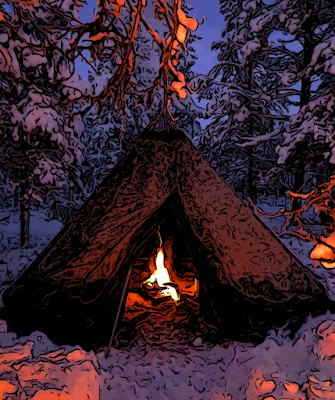
The next step of establishing camp was a critical one. The Company of the Dragon, like all traveling Orlanthi, would have made use of a "traveling house," a structure not unlike the lavvu used by the Sami peoples of Europe or the tipi of indigenous North Americans. The skeleton of the structure was formed by three notched or forked poles, arranged like the Movement Rune to form a tripod, with additional straight poles added between to lend support. Over this was stretched walls of animal hides and skins. The center of the traveling house was left open to the sky, and on the ground beneath it each one would have a small campfire within.
Along with the Law Stone, the leader of the band or company would carry with them a fired clay box containing a single coal. This was the sacred essence of Oakfed, a Low Fire spirit and brother to Mahome (the hearth) and Gustbran (the forge). In the center of the camp, beside the Law Stone, the leader would then create the Camp Fire. From this, each fire within each tent would then be lit. Hymns would be chanted or sung in memory of Oak Fed helping the ancestors survive in the Greater Darkness. Once the fires were lit, the camp was said to have "woken up," and was considered a temporary yet acceptable surrogate for the hearth fire of Mahome burning at the heart of every permanent Orlanthi dwelling.
On a final note, latrines would have been dug several meters from the edge of camp. The Orlanthi practice was to dig them in the north, likely as a slight to the Dara Happan peoples in that direction.
Camp Life
Evenings would be given over to songs, stories, and the retelling of ancient myths. The shift rotation of guards patrolling the outer edges of the camp would have been assiduously observed. Food would primarily be hard, dried breads softened and flavored with gravies made from dried stock, cured meats, beans and lentils, and if they were lucky a bit of beer. If the band was given permission to hunt on the lands it occupied, game might be added to the menu. In general though, within two hours of sunset, the camp would have gone quiet.
Traveling houses were large, and often held up to ten individuals. For the Company of the Dragon, where Companions trained in phalanx formations of ten, the Company would have bedded down in their phalanx groups. Romantic relationships were known and accepted, and would have been quietly ignored by other tent mates.
In the morning the members would rise with the dawn and wash, not just for cleanliness but as a ritual purification washing away any lingering traces of sleep, the "little death." In Sea, Fire, and Earth Seasons the camp would optimally be placed near a source of flowing water for this purpose. In Dark and Storm Seasons, snow would be brought into the tent to melt overnight in vessels beside the camp fires. The company would then break its fast, and engage in the militia training or other occupations of the day.
A Word on Hospitality
It should be noted that once the Law Stone was planted and the fires lit, the camp for all intents and purposes belonged to the band or company occupying it. Even if they had been given permission to encamp on someone else's clanstead, by ancient Orlanthi custom and tradition the land belonged to the campers, not the owners. No member of the local residents would enter the camp without announcing themselves and receiving permission first. To do so would have been a serious breech of protocol. Likewise, no party would set up camp on the lands of others without first securing permission, and it was recognized that by encamping on other's lands you established and now owed a debt to them.
Thursday, March 18, 2021
"THE COMPANY OF THE DRAGON" IS OUT!
We are proud to announce that The Company of the Dragon was released two days ago and became an instant bestseller, holding the #1 spot not only in Community Content but ALL of DriveThruRPG.
In the shadow of the Quivini, at the dawn of the Hero Wars, a young Seven Mothers convert began collecting stories of rebel warbands hiding in the wilds of occupied Sartar.
Among these accounts were repeated stories of one particular warband... clanless, tribeless, bound to a draconic spirit of immense power. Some called them traitors and insurrectionists. Others painted them as folk heroes and freedom fighters.
They were called the Company of the Dragon. And some say they helped the Prince of Sartar win her throne.
In this 270-page sequel to the Gold bestselling SIX SEASONS IN SARTAR you will find:
- "Sartar Before the Dragonrise," a land culturally and politically divided under foreign dominion.
- "The Company of the Dragon," a description of the Company, the rebel warbands loyal to Kallyr, and a new system to model large communities, keep them healthy and strong, and lead them into large scale battles.
-"Draconic Consciousness," the teachings of the Dragon Way and a Draconic perspective of the Hero Wars.
-"Characters," rules for creating new protagonists, creating and narrating "character arcs." and a shorthand system for NPCs and antagonists, with over 30 templates for quick NPC design.
-"Initiations," a discussion of this important aspect of Gloranthan religions, with example initiations for martial cults like Orlanth Adventurous, Vinga, Humakt, Babeester Gor, Storm Bull, and the Company of the Dragon.
-"Running the Game," an extensive chapter on building campaigns, with expanded battle and community management rules, new options, and a discussion of gaming in Glorantha.
-"Episodes," more than 160 pages of adventures and adventure seeds that allow you to assemble your own 5-year, 27-season saga, with historical events like "The Battle of Auroch Hills" and "The Dragonrise," as well as all-new stories like "The Dark Lord's Daughter" and "The Changeling."
Written for RuneQuest: Roleplaying in Glorantha, but with support for 13G and Questworlds play.
Usuable as a solo campaign or the sequel to SIX SEASONS IN SARTAR.
Sunday, December 20, 2020
THE COMPANY OF THE DRAGON, AN UPDATE
Introduction
As J.R.R. Tolkien phrased it, "the tale grew in the telling." The project started as one thing, but then just kept growing and growing and growing. Now, as Six Seasons in Sartar: The Company of the Dragon nears completion, I thought it would be a good time to pull the curtain back on the campaign and let you know just what you have in store for you. We are in the layout and art stages right now, adding some final material and a fresh new chapter I hadn't planned on including, but decided it needed, and am looking towards a mid-January release date. I will keep you posted if there are any delays.
The Company of the Dragon is the sequel to Six Seasons in Sartar, but we have spent a lot of time and effort making sure you can run it as its own campaign, without ever having played Six Seasons at all. If you did play Six Seasons, then The Company of the Dragon will tell you what happens next. Your Six Seasons player characters will become the main protagonists of this saga, and you can bring along any of the NPCs who survived the Battle of Black Stag Vale as well. If you never played Six Seasons, you and your friends will sit down and create brand new characters for the campaign.
The Saga
The story follows "the Company of the Dragon," one of the rebel warbands operating in Sartar between Earth Season 1620 ST and Kallyr's ascension as Prince in 1625. Traditionally, the Orlanthi warband was a group of young men following Orlanth Adventurous and fighting women following Vinga sponsored by their clan and overseen by the Orlanth Rex cult. The warband's actions were sanctioned and given legitimacy by this oversight. They quested, conducted cattle raids, fought Chaos, all on behalf of their clan and their chieftain. With the Lunar Occupation, however, the Orlanth Rex cult was banned, leaving warbands across Sartar without guidance, authorization, or control. Some turned to banditry. Some became mercenaries. But some took a different route.
Kallyr of Kheldon, in exile since leading a failed rebellion against the Empire in 1613, saw in these warbands an opportunity. As holder of the Iron Torc, Kallyr is the High Priest of Orlanth Rex, and she reached out to the leaderless warbands of Sartar offering them a deal. If they fought for her, under her authority, she would grant them the sanction and legitimacy the Orlanth Rex cult offered of old. This gave Kallyr a private army of rebels scattered throughout the hills of Sartar. For the warbands, it was a lifeline.
Because Sartar before the Dragonrise is a nation divided against itself. The tribal kings and queens, as well as the cities, have largely accepted Prince Temertain and Lunar rule. Many of them profit from it, in fact, now having access to a far larger network of trade routes than ever before. The clans living amongst the hill tribes of Sartar, however, cling fiercely to the Old Ways. In their eyes, Kallyr is the legitimate Prince of Sartar and Temertain a pretender. The warbands operating in her name thus gain aid, support, and comfort from the hill tribes, while in the cities they are viewed as bandits and terrorists.
If you are coming from Six Seasons in Sartar, the Company of the Dragon is composed of the surviving Haraborn, joined by the Third Wind and other rebel groups operating in Kallyr's name. These are all united, and forged into a new community, by the Draconic spirit Shah’vashak the Rainbow Wyrm. Discovered imprisoned in a Second Age EWF temple, Shah’vashak is a severed piece of the Brown Dragon's soul. Kallyr needs it, and the other severed pieces, to awaken the Brown Dragon as a weapon against the Lunars, but Shah’vashak has its own plans. The Company of the Dragon introduces a new twist on an old Gloranthan myth, and a unified vision that ties together the constellation Orlanth's Ring, the Dragonrise, Argrath, and the end of the Third Age...
If you are new to all this, the book will walk you through creating your own Company, where they came from, and how they met the Rainbow Wyrm.
A Five-Year Adventure
The campaign consists of 23 possible adventures, one per season. The book gives you, however, more than 50 episodes which can be used to fill these slots. Episodes can be combined or run on their own, which means with 23 openings and over 50 choices, no two campaigns need play alike and you can replay The Company of the Dragon differently each time.
The timeline is likewise divided into three phases; "Guerrilla War" in which the Company is always on the move, hiding out in the hills and striking at the Lunars every chance that they get; "The Great Winter," in which the Company has the chance to secure a base of operations and faces the challenge of helping its allies survive the darkness that descends in the wake of Orlanth and Ernalda's "deaths," and "The Dragon Rising" which brings the Company back into Kallyr's path as she needs them to awaken the Brown Dragon and liberate the land.
Along the way the player characters have the chance to tangle with Delecti and Sir Ethilrist, to negotiate with Mostali, Uz, and Aldryami, to participate in the Battle of Auroch Hills and witness the Dragonrise.
New Systems
The Company of the Dragon introduces a simple, streamlined resource management system which allows the players to govern the warband, use its power to create changes in the world, and puts them in the position of having to strengthen and maintain it. It also introduces Draconic Conscious, a form of Illumination taught by Shah’vashak the Rainbow Wyrm. Also included are "Character Arcs," a simple narrative system that shifts the spotlight from character to character over the campaign as they pursue their own personal development and goals, and expanded use of "Character Ratings" or "CR" from Six Seasons in Sartar.
Stay Tuned
I will be looking more closely at aspects of the campaign as the release date approaches. Stay tuned here for additional information and sneak previews.
Tuesday, December 1, 2020
LIFE OF MOONSON, BOOK ONE: CHARACTERS - A LOOK
THE ARGUMENTS GO BACK forty years.
You have the Roman Camp, who will point to the Imperial legions, the liberal use of terms like "centurion" and "tribune," and the existence of a Senate. Obviously this makes Sartar Gaul or Germania...possibly even Judea. Then you have the Persian Camp, who remind you of the Satraps and sultanates. This casts Sartar in the role of the brave Greeks holding off the forces of Xerxes I. There is a Byzantine Camp, who point out the existence of a state religion that is keen on conversion, a Soviet Camp who view the insidious spread of "Illumination" as a euphemism for Communism (not to mention, the empire is "Red"), and even a Star Wars "The Empire" Camp...because let's face it, there is something rather Death Star-like about the Red Moon just hovering there. Each side, given the chance, has made convincing cases initially around gaming tables, then later message boards, and nowadays the Internet.
Of course the real answer is simple. The Lunar Empire is all of these things.
In a world based on myth, the Lunar Empire is the archetypical Empire, a mold into which you can pour any empire you like (or dislike, for that matter). Alternatively, if you are the team that put together 2020's A Rough Guide to Glamour, you cram that mold close to bursting with every single empire you can think of. Glamour served up a Lunar Empire that was simultaneously Rome, Byzantium, Moscow, Britain, Palpatine's, and more than a little Oceania, spiced up with pop culture and humor, and served hot in the Jonstown Compendium. Now the band is back together for Life of Moonson, Book One: Characters.
Both A Rough Guide and Moonson originated with a LARP run at Gloranthan conventions in the late 1990s. It was a strange period of history for "Glorantha in the real world," when the setting had just split from RuneQuest but had not yet been reborn in Hero Wars (later HeroQuest). Yet this LARP played a crucial role in assembling the Avengers, the people who would become--in the words of Jeff Richard--"a veritable Who's Who of the modern Team Chaosium." So it felt "right" for a Rough Guide to be expanded, illustrated, and published for the new Jonstown Compendium, and it feels right for the Life of Moonson books to follow it now.
While A Rough Guide detailed the setting of the LARP--the Lunar Empire's capital of Glamour--this volume, Characters, contains more than 50 characters for it, each illustrated, with pages of description background, personal objectives, secrets, and things the character knows. There are no game statistics here, but the characters are so complex and fleshed out that adding a few for RuneQuest or QuestWorlds would be well worth your while. These are the movers and shakers of the Lunar Empire. the heaviest of the heavy hitters. Within you will find the Red Emperor himself, Sor-Eel, the Great Sister, the Dean of the Field School of Magic, even Jar-Eel the Razoress. This makes it invaluable to anyone wanting to run a campaign in the capital, or at the highest levels of the Empire. For the rest of us, its just makes for damn juicy reading.
The production values are upped here from A Rough Guide, which is actually saying something as that book set the bar for other Compendium works. The writing team of David Hall, Kevin Jacklin, Nick Brooke, Chris Gidlow, the notorious MOB (Michael O'Brien), and Mike Hagen are joined by illustrator Dario Corallo, whose art so perfectly matches the spirit of the book. As with A Rough Guide, Moonson portrays the luminaries of the Empire in the guise of famous actors, performers, and artists we all know. I will leave it to you, gentle reader, to identify them all at your leisure.
At 235 pages Life of Moonson is massively expanded from its original source material, with new essays and maps courtesy Phil Anderson and Nick Brooke. Book Two: The Rules, is on the way and will deliver the basic story of the LARP (seven years after the Dragonrise, the great and the good of the Empire have come together the celebrate the Lunar New Year...), the rules, and tools needed to run it.
Even if you have no intention of playing the LARP, Life of Moonson belongs in your collection along with A Rough Guide to Glamour. LARPs have never been this reviewer's cup of tea, but I still find both books terrific RPG references. Like so much from the Compendium they are passion projects, and it shows. They also shed light (scarlet, crimson, and vermillion light, of course) on a part of Glorantha we don't often get to see.
Life of Moonson is available now in PDF from the Jonstown Compendium. Buy a copy, and help it get past the threshold for print on demand eligibility.