There are places in this world that humanity was never supposed to see- walled in by mountains of burning black rock, isolated by a choking canopy of poison flora, woods where tooth, claw, and hunger still sit atop the food chain. Long before our kind ever set foot in these mountains, when the peaks of the Blue Ridge towered above the stars, and the heart of the plateau still rolled with ridges tough as pine knobs, darkness was brought here in cages made of fear. Our tongues do not have the shape to speak the true names of what they are . . . and that's are, not were. They are hunger, consumption, lust- all the things that settle under the heart and below the ribcage. They are the cancer that will one day eat the edges of this universe, and leave nothing in its place. They are not evil. They are not of Hell or the Christian devil. They simply are...
Old Gods of Appalachia, Season 1, Episode 0: "Prologue"
A Surprisingly Personal Connection
I don't often get to review a game that leads me to discover something about myself.
I was interested in Old Gods of Appalachia (the RPG) since I first caught wind of it. I love the Cypher System and have reviewed it extensively, as well as Numenera and VURT. In addition, I am a lifelong horror buff, though I had not originally listened to the podcast the RPG is based on, the premise of the game (so perfectly summed up in the quote above) sent shivers down my spine. When Old Gods finally arrived I started reading it, and simultaneously listened to the podcast...and that is when the sense of deja vu started to hit me.
When I was a boy of eleven, circumstance drove my family from suburban Arizona back east, to family. We moved to rural upstate New York, to a fairly isolated community in the Catskill Mountains. My great-grandmother had about 200 acres of land there, seven miles deep in one of the "small, sheltered valleys" Old Gods of Appalachia calls as a "holler:"
A holler has a head, a mouth, and often a creek, even if it’s only seasonal. The mouth is the least remote and typically broadest part of the holler, being its start; it’s also typically where the holler’s creek—if it has one—joins a larger creek or stream. The head is the most remote part of the holler, nestled near where the ridges meet. Houses are situated along the slopes of occupied hollers, with a road in the middle, running roughly parallel to the water source.
This was exactly where she lived, along a dirt road impassable in the winters. And it was--like all the narrow little valleys hidden in those mountains--called a "hollow." Bouck's Hollow, to be exact. Author's Note: before publishing this I ran it by a friend who grew up there. He reminded me that I was an outsider...I might have called Bouck's Hollow, Polly Hollow, Preston Hollow etc "hollows" but everyone else did indeed call them "hollers."
As I kept reading, and listening, it was like my childhood flashing before my eyes. The section on weather related disasters in Appalachia (p. 184) talked about flooding. In 1987, when I was sixteen, the Schoharie Creek flooded nearly the entire town, and has flooded several times before and since. In discussing the geology of the mountains, these were the mountains I remembered, shale and limestone, and impossibly ancient. You could climb those mountains and at their summits find the fossils of prehistoric sea life frozen in the shale, and not so far from where I lived was the Gilboa Fossil Forest, petrified trees 385 million years old and believed to perhaps be one of the first forests on the face of the Earth.
As I read about the people, and listed to the stories, that was when I really began to relate. I knew these people...the townfolk, the farmers in the valleys...and the folk up in the hollows (hollers). In a July 18th article from 1991, the New York Times published a piece about them:
Along the sinuous West Middleburgh Road that makes its way through the rolling green hills lie crumbling old shacks surrounded by chickens, decaying barns, rusting farm machinery and tiny overgrown family plots. Here, families with names that have been known in these parts for more than 200 years live lives that often seem untouched by modernity… The insular life in the hollow has preserved old folk beliefs, arcane slang and diversions, like cockfighting, that are illegal in New York State. Nearly every dirt yard has at least one majestic rooster with a foot tethered on a string to a stake, waiting for the next cockfight. Foxes are kept in cages out in back of properties, which are often more than a hundred acres. Some houses lack indoor plumbing, but few lack American flags...
Now, if you hear a bit of Big City Contempt in some of that, you are not alone, and one thing Old Gods of Appalachia (the RPG) gets very, very right is avoiding ugly stereotypes about the people of the region. But the article is mostly right, and trust me when I say the people in the hollows had just as much contempt for the city folk.
The point I am arriving at is the more I read Old Gods the more it echoed my own experience. But I grew up in New York, not Appalachia...didn't I? Didn't I?
Turns out, officially, I did grow up in Appalachia.
People don't associate New York State with Appalachia. In a 1981 governmental study, only 20% of those surveyed identified the region as extending north into that state. Yet the Catskill Mountains are just as much a part of the Appalachian Mountain chain as the Blue Ridge Mountains are, and 14 New York counties are also official members of the Appalachian Regional Commission. When Congress created the Commission back in 1965, part of its mandate was to define what Appalachia actually "was" according to cultural, historical, and socio-economic factors. Their conclusion was that these 14 counties did indeed belong. I grew up in the one that forms the northeastern most tip of the region. The culture in the hollows/hollers of that mountain chain runs deep, and the more I looked the more I found. Linguistic connections. Common traditions. Shared beliefs.
And...well, the weirdness.
There is something in those mountains. You feel it. Something impossibly old. Something deep. In the 18th and 19th centuries, the slopes of the hills where I grew up were all cleared for hops farms. In the 1910s, a hops blight came, and then Prohibition finished the job. The farms were just abandoned, and by the time I was there, the forests had swallowed them back up. You could walk through the woods and come across a wall of neatly stacked shale which had once marked the boundaries of a field, or come across the ruins of a farmhouse, the trees grown right up through the foundations. Then everything would go quiet, and you could almost feel something looking into you. The Green, if you were lucky...the Things if you were not.
But I get ahead of myself, Family. Let's talk about Old Gods.

Part 1 "Where the Shadows Stir" and Part 4 "The Darkest Mountains in the World"
A 418-page PDF and book, Old Gods of Appalachia is full-color, profusely illustrated, and for the print version on thick, glossy paper. If you own Numenera or the Cypher System core books you know the general quality and style you will be getting. Kyle A. Scarborough's cover depicts "The Thing Whose Name Sounds Like Horned Head But Is Not," aka "The Beast," "The Maker of the Poisoned Promise," "The Liar Saint," "The Uncast Shadow," and my favorite--for personal reasons--"The Black Stag."
The book begins with a full page introduction by the authors and creators of the original podcast, Steve Shell and Cam Collins. Click that link sometime and give it a listen. This Introduction, along with Part 1 and later Part 4, give you a general overview of the setting, so lets talk about that all first.
Set in a slightly alternate Appalachia in the early decades of the 20th century (with some episodes set later and some before), Old Gods of Appalachia (game and podcast) speaks of the powers in these mountains, and the effects of their interaction with the human communities living in them. Most dread of these powers is the Inner Dark. Hundreds of millions of years ago, when these mountains soared far higher and steeper than they do today, Those Who Sleep Beneath were imprisoned beneath them. Not gods, their power is godlike, and should they escape their prison it would be the end of humanity if not all life on Earth. As entire geological ages passed and these mountains were slowly weathered down into the rolling hills and hollers we know today, Those Who Slept Beneath were able to exert some of their power, calling humans to settle in this region, to seek them out, and to dig. The greatest servants of these eldritch horrors are the Deep Things, like the Blag Stag on the cover, the generals of the Inner Dark's armies. Next come the Middle Things, powerful horrors and servants, followed by the Low Things, mostly mindless animal-lever terrors used as hunting dogs and shock troops.
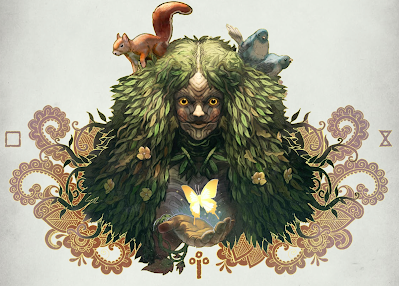
What locked the Inner Dark below the mountains? Possibly the other great power in these mountains...the Green. less malignant that the Inner Dark certainly, the Green is nevertheless the raw and untamed power of life and nature. Creation, destruction, recycling. The Green is the food chain and the breeding cycle, overwhelming instinct, but also health and healing. Folk in these mountains can sometimes use its magic to their own benefit, as well as against the Inner Dark.
There are other powers, independent ones. The Boy. Jack. The Railroad Man. The Dead Queen. But the ones above are the primary forces player characters will be dealing with.

The horror in the podcast and game leans heavily on folk horror, but I would argue it is more of a thing in itself. Folk horror is rooted in old superstitions, paganism, the isolation of a rural setting, cryptids, and folk magic/religion. All of those elements are indeed present here, but the inclusion of forces like the Green and the Inner Dark make Old Gods of Appalachia something different. Folk horror tends to be "us vs. them," with "us" being urban outsiders and "them" being the locals. Midsommer, The Ritual, Children of the Corn, and The Wicker Man are all excellent examples. The outsider comes to the region, gets caught up in the dark local magic, and horror ensues. Had Dracula just been the initial 40 pages of Jonathan Harker's journal, it would have fit the bill.
But that is not really Old Gods of Appalachia at all. Instead, it is often a case of the rural local people drawing on folk magic, lore, and traditions (see below) against the eldritch power of the Inner Dark, or other horrific enemies. In this way I think Old Gods reinvigorates the genre by jettisoning some of its more tired tropes and at the same time seeing the folk of the hills and hollers as protagonists rather than antagonists.
To that end, Part 4 digs deeper into the setting, with an overview of central Appalachia (the game does not extend south into Mississippi, Alabama, or Georgia, or north into New York). The geology, geography, weather, flora and fauna of the region are summarized, as well as the history and origins of its people. there is a broad look at the people and how they lived, both in the hollers and in the towns and cities. Communication, transportation, entertainment, commerce, and because of the time period Prohibition, are all discussed Specific locations and characters from the podcasts are detailed here as well.
One of the more critical sections (as touched on above) is the discussion of Appalachian magic, ranging from the folk magic known as "witchcraft" and "granny magic" to the magic of the Green and the Inner Dark. Magic plays a bigger role than it might in a Call of Cthulhu adventure, because this is not the alien magic of Lovecraft's "cosmicism." Sanity, and madness, is not at much a part of the game. Yes, the magic of the Inner Dark is ultimately corrupting, but the folk magic of the hills and the power of the Green can often be called as a weapon against it. These are ultimately isolated, self-reliant communities that must look out for themselves when the monsters come crawling. They cannot wait on the learned men from Miskatonic to always show up on time.
Part 2 "Welcome to the Family"
This section then, a full 100+ pages, is character creation. This sounds like a lot, but if you know games powered by the Cypher System at all you will see it is really about offering you a selection of detailed choices rather than complexity.
But here is where I come to the first mention of what I am not going to be doing here. As mentioned earlier, I have a very detailed and in-depth review of the Cypher System here, so if you are not at all familiar with the game and you want to understand Old Gods of Appalachia's rules, I urge you to go there. Here I would prefer to focus on this incarnation of the system.
At your core the characters in Old Gods are still defined by Might, Speed, and Intellect, with Pool, Edge, and Effort being important factors of those traits. There are still six tiers to rise through.
Characters are also still defined by Descriptor, Type, and Focus. Namely "I am an (adjective) (noun) that (verbs). The character Types are now Protectors (Cypher System Warriors), Sages (Adepts), Explorers (Explorers), and Speakers (Speakers). All have been give rewrites to make them fit better into the specific setting.
Some of the Descriptors are familiar, but a surprising number are new here, again, tying specifically into the Appalachian setting. For example, "Superstitious" comes with a boxed text of Appalachian superstitions your character likely subscribes to. The same is true of the Foci, with setting-specific ones like "Serves the Green" and "Fears no Haints" to others that resemble ones we have seen before, but are repurposed here for the period ("Cures What Ails Ya" or "Makes a High Lonesome Sound").
Through these descriptions, Old Gods frequently offers quotes from the podcast, tying these game features back to characters and situations in the anthology. The section finishes out with "Goods and Currency," which almost feels like it really belongs in the section on Appalachia for the amount of detail it gives on the setting.
Part 3 "Playing the Game"
This is really just the Cypher System rules...determining the task stat and difficulty, modifying the difficulty, and rolling a d20. Skills, assets, and effort all work the same way. It is still player-facing, meaning the GM doesn't usually roll any dice. Experience is still handing through intrusions, and the game includes a number of setting-specific character arcs to play through.
Part 5 "Running the Game" and Part 6 "Adventures"
After thorough and comprehensive advice on running the system, Old Gods of Appalachia comes back to the setting again with a really terrific assortment of just under 100 setting-specific Cyphers and about half as many Artifacts. Cyphers are one-use items, Artifacts can be used multiple times but often with a chance of "coming due," losing their powers permanently or needed somehow to be re-awoken. For me, these two sections really make the game unique. For example, the "Circle of Safety" cypher is a mason jar filled with churchyard dirt, ant eggs, seven nails, lye, gunpowder, and saltpeter. Pouring the contents in a circle around you and setting it alight will protect you with a nearly impenetrable barrier. A 'Fear Knot" is a hemp rope woven with animal hair soaked in spring water of seven days. Whisper your deepest fear to it, and the next 24 hours you are given protection against fear. The cyphers, and the artifacts, are all drawn from folklore and folk magic, giving tremendous flavor to the game.
"Haints, Spirits, and Revenants" come next, the chilling antagonists of the podcast and Appalachian folklore. The Powers mentioned earlier are all here (the Boy, Jack, the Dead Queen, etc) as well as a wide assortment of Things of the Inner Dark and a few "must-include" NPCs like the Witch Queen. I will not describe them because I want to spoil neither the podcast not the game for you, but for a game being called "eldritch horror" this is another area it distinguishes itself in.
The horrors of the Cthulhu Mythos, as magnificent as they are, arise from Lovecraft's "cosmicism," that humanity is insignificant and without meaning in a vast, uncaring cosmos. The entities encountered are horrific because they are alien. Old Gods of Appalachia is different. The Inner Dark is about the horrors buried deep in the human heart. There is more a sense of Stephen King than Lovecraft to the podcast and it carries over beautifully to the game. These horrors will tempt you and corrupt you, because they seem to have an understanding of humanity that the Great Old Ones do not. It creates a very different sort of horror experience at the table.
Finally, the book closes with not one but two sample advantures, both exemplifying the kinds of stories Old Gods of Appalachia can tell.
Closing Thoughts
Neither Lovecraftian cosmic horror nor folk horror, Old Gods of Appalachia seems to be an alloy of both, making it neither. Lovecraft, I think, is "city horror," and more than that, "modern city horror." It is about a world that has lost meaning, or perhaps never had it...a world in which each new discovery takes us closer to madness.
Old Gods of Appalachia is different. "There are ancient powers...but listen to the wisdom of your ancestors so that you can deal with them. The game includes cities but is is deeply rural, and it expresses darknesses and secrets I think one can only understand if you embrace the setting, where modernity had been kept at bay and old truths remembered.
I am particularly pleased that Shanna Germain and her team remained so committed to using the Cypher System here. I liked Invisible Sun but never fully grasped why a modified Cypher System was designed for it. Maybe because I grew up on Chaosium, I like house systems. Cypher was perfect for this.
Buy this game if you are looking for a unique form of horror. Listen to the podcast and I can almost guarantee you will but it.