Welcome!

"Come now my child, if we were planning to harm you, do you think we'd be lurking here beside the path in the very darkest part of the forest..." - Kenneth Patchen, "Even So."


THIS IS A BLOG ABOUT STORIES AND STORYTELLING; some are true, some are false, and some are a matter of perspective. Herein the brave traveller shall find dark musings on horror, explorations of the occult, and wild flights of fantasy.

Monday, March 22, 2021

THE COMPANY OF THE DRAGON: CAMP LIFE

THE ORLANTHI ARE NOT a nomadic people, yet neither are they as sedentary as many other Gloranthan peoples. The ancient Vingkotlings, for example, were stationary, with holds and steads firmly established, but their immediate successors were not.  Heort's "Deer People" lived in the mountains and hills outside of the cities and forts, a tactic that kept them alive in the Greater Darkness. Modern Orlanthi blended these two cultures, with Esrolia and Sartar's cities exemplifying the settled patterns and the Pol Joni showing more mobile instincts.

The longhouses, halls, and hill forts of late Third Age Sartar might have had their roots in the Vingkotling stream, but the nomadic lifestyle adopted by rebel forces during the Lunar Occupation (1602 to 1625 S.T.) harkened directly back to Heort. Before coming to occupy (if, in your campaign they do at all) the ancient Vingkotling fortress of Storm's Age (p. 219-226), the Company of the Dragon adopted a lifestyle that their distant Heortling ancestors would have found very familiar.

Setting Up Camp

The practice of establishing camp was ritual, formalized, and rooted in myth.  It began not with Orlanth but Umath himself. First, the recognized leader of the band locates what is to be the center of camp and plants the Law Stone there. This is a sacred stone created at the formation of the band or company and brought with them whenever they break camp and establish a new one elsewhere. The Law Stone traditionally has carvings identifying who the band is, who their leader is, and perhaps most critically who their wyter is. It was not unusual, in fact, for the Law Stone to be the sacred vessel containing the wyter's spirit (see RQ, p. 286).  Once planted, the Law Stone marks the camp as belonging--so long as it remains--to the band or company.  Umath established this tradition, but it is also clearly a reflection of the Spike that stood at the heart of Glorantha.

The highest ranking priest or God-talker among them would then call the Six Guardians to encircle and mark the boundaries of the camp;

I call upon the Six Guardians of the camp; I call upon the spirits Before Me, On My Right, Behind Me, On My Left, Above Me, and Below Me. 

Often this was accompanied by use of the Warding Rune spell (RQ, p. 347), but not generally if the camp was being established in the territory of an allied or friendly host.

Sacred Fire

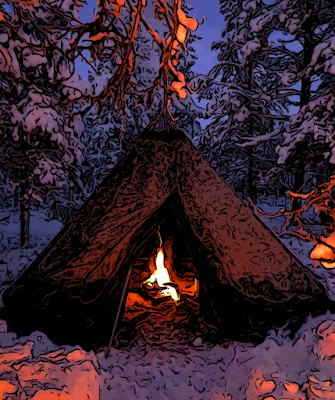
The next step of establishing camp was a critical one. The Company of the Dragon, like all traveling Orlanthi, would have made use of a "traveling house," a structure not unlike the lavvu used by the Sami peoples of Europe or the tipi of indigenous North Americans.  The skeleton of the structure was formed by three notched or forked poles, arranged like the Movement Rune to form a tripod, with additional straight poles added between to lend support.  Over this was stretched walls of animal hides and skins.  The center of the traveling house was left open to the sky, and on the ground beneath it each one would have a small campfire within.

Along with the Law Stone, the leader of the band or company would carry with them a fired clay box containing a single coal. This was the sacred essence of Oakfed, a Low Fire spirit and brother to Mahome (the hearth) and Gustbran (the forge). In the center of the camp, beside the Law Stone, the leader would then create the Camp Fire. From this, each fire within each tent would then be lit. Hymns would be chanted or sung in memory of Oak Fed helping the ancestors survive in the Greater Darkness. Once the fires were lit, the camp was said to have "woken up," and was considered a temporary yet acceptable surrogate for the hearth fire of Mahome burning at the heart of every permanent Orlanthi dwelling.

On a final note, latrines would have been dug several meters from the edge of camp. The Orlanthi practice was to dig them in the north, likely as a slight to the Dara Happan peoples in that direction.

Camp Life

Evenings would be given over to songs, stories, and the retelling of ancient myths. The shift rotation of guards patrolling the outer edges of the camp would have been assiduously observed. Food would primarily be hard, dried breads softened and flavored with gravies made from dried stock, cured meats, beans and lentils, and if they were lucky a bit of beer. If the band was given permission to hunt on the lands it occupied, game might be added to the menu. In general though, within two hours of sunset, the camp would have gone quiet.

Traveling houses were large, and often held up to ten individuals. For the Company of the Dragon, where Companions trained in phalanx formations of ten, the Company would have bedded down in their phalanx groups. Romantic relationships were known and accepted, and would have been quietly ignored by other tent mates.

In the morning the members would rise with the dawn and wash, not just for cleanliness but as a ritual purification washing away any lingering traces of sleep, the "little death." In Sea, Fire, and Earth Seasons the camp would optimally be placed near a source of flowing water for this purpose.  In Dark and Storm Seasons, snow would be brought into the tent to melt overnight in vessels beside the camp fires.  The company would then break its fast, and engage in the militia training or other occupations of the day.

A Word on Hospitality

It should be noted that once the Law Stone was planted and the fires lit, the camp for all intents and purposes belonged to the band or company occupying it. Even if they had been given permission to encamp on someone else's clanstead, by ancient Orlanthi custom and tradition the land belonged to the campers, not the owners. No member of the local residents would enter the camp without announcing themselves and receiving permission first. To do so would have been a serious breech of protocol. Likewise, no party would set up camp on the lands of others without first securing permission, and it was recognized that by encamping on other's lands you established and now owed a debt to them. 


Thursday, March 18, 2021

"THE COMPANY OF THE DRAGON" IS OUT!

We are proud to announce that The Company of the Dragon was released two days ago and became an instant bestseller, holding the #1 spot not only in Community Content but ALL of DriveThruRPG.  

In the shadow of the Quivini, at the dawn of the Hero Wars, a young Seven Mothers convert began collecting stories of rebel warbands hiding in the wilds of occupied Sartar.

Among these accounts were repeated stories of one particular warband... clanless, tribeless, bound to a draconic spirit of immense power. Some called them traitors and insurrectionists. Others painted them as folk heroes and freedom fighters.

They were called the Company of the Dragon. And some say they helped the Prince of Sartar win her throne.

In this 270-page sequel to the Gold bestselling SIX SEASONS IN SARTAR you will find:

- "Sartar Before the Dragonrise," a land culturally and politically divided under foreign dominion.

- "The Company of the Dragon," a description of the Company, the rebel warbands loyal to Kallyr, and a new system to model large communities, keep them healthy and strong, and lead them into large scale battles.

-"Draconic Consciousness," the teachings of the Dragon Way and a Draconic perspective of the Hero Wars.

-"Characters," rules for creating new protagonists, creating and narrating "character arcs." and a shorthand system for NPCs and antagonists, with over 30 templates for quick NPC design.

-"Initiations," a discussion of this important aspect of Gloranthan religions, with example initiations for martial cults like Orlanth Adventurous, Vinga, Humakt, Babeester Gor, Storm Bull, and the Company of the Dragon.

-"Running the Game," an extensive chapter on building campaigns, with expanded battle and community management rules, new options, and a discussion of gaming in Glorantha.

-"Episodes," more than 160 pages of adventures and adventure seeds that allow you to assemble your own 5-year, 27-season saga, with historical events like "The Battle of Auroch Hills" and "The Dragonrise," as well as all-new stories like "The Dark Lord's Daughter" and "The Changeling."

Written for RuneQuest: Roleplaying in Glorantha, but with support for 13G and Questworlds play.

Usuable as a solo campaign or the sequel to SIX SEASONS IN SARTAR. 

Sunday, December 20, 2020

THE COMPANY OF THE DRAGON, AN UPDATE

Introduction 

As J.R.R. Tolkien phrased it, "the tale grew in the telling."  The project started as one thing, but then just kept growing and growing and growing.  Now, as Six Seasons in Sartar: The Company of the Dragon nears completion, I thought it would be a good time to pull the curtain back on the campaign and let you know just what you have in store for you.  We are in the layout and art stages right now, adding some final material and a fresh new chapter I hadn't planned on including, but decided it needed, and am looking towards a mid-January release date.  I will keep you posted if there are any delays.

The Company of the Dragon is the sequel to Six Seasons in Sartar, but we have spent a lot of time and effort making sure you can run it as its own campaign, without ever having played Six Seasons at all.  If you did play Six Seasons, then The Company of the Dragon will tell you what happens next.  Your Six Seasons player characters will become the main protagonists of this saga, and you can bring along any of the NPCs who survived the Battle of Black Stag Vale as well.  If you never played Six Seasons, you and your friends will sit down and create brand new characters for the campaign.

The Saga

The story follows "the Company of the Dragon," one of the rebel warbands operating in Sartar between Earth Season 1620 ST and Kallyr's ascension as Prince in 1625.  Traditionally, the Orlanthi warband was a group of young men following Orlanth Adventurous and fighting women following Vinga sponsored by their clan and overseen by the Orlanth Rex cult.  The warband's actions were sanctioned and given legitimacy by this oversight.  They quested, conducted cattle raids, fought Chaos, all on behalf of their clan and their chieftain.  With the Lunar Occupation, however, the Orlanth Rex cult was banned, leaving warbands across Sartar without guidance, authorization, or control.  Some turned to banditry.  Some became mercenaries.  But some took a different route.

Kallyr of Kheldon, in exile since leading a failed rebellion against the Empire in 1613, saw in these warbands an opportunity.  As holder of the Iron Torc, Kallyr is the High Priest of Orlanth Rex, and she reached out to the leaderless warbands of Sartar offering them a deal.  If they fought for her, under her authority, she would grant them the sanction and legitimacy the Orlanth Rex cult offered of old.  This gave Kallyr a private army of rebels scattered throughout the hills of Sartar.  For the warbands, it was a lifeline.

Because Sartar before the Dragonrise is a nation divided against itself.  The tribal kings and queens, as well as the cities, have largely accepted Prince Temertain and Lunar rule.  Many of them profit from it, in fact, now having access to a far larger network of trade routes than ever before.  The clans living amongst the hill tribes of Sartar, however, cling fiercely to the Old Ways.  In their eyes, Kallyr is the legitimate Prince of Sartar and Temertain a pretender.  The warbands operating in her name thus gain aid, support, and comfort from the hill tribes, while in the cities they are viewed as bandits and terrorists.

If you are coming from Six Seasons in Sartar, the Company of the Dragon is composed of the surviving Haraborn, joined by the Third Wind and other rebel groups operating in Kallyr's name.  These are all united, and forged into a new community, by the Draconic spirit Shah’vashak the Rainbow Wyrm.  Discovered imprisoned in a Second Age EWF temple, Shah’vashak is a severed piece of the Brown Dragon's soul.  Kallyr needs it, and the other severed pieces, to awaken the Brown Dragon as a weapon against the Lunars, but Shah’vashak has its own plans.  The Company of the Dragon introduces a new twist on an old Gloranthan myth, and a unified vision that ties together the constellation Orlanth's Ring, the Dragonrise, Argrath, and the end of the Third Age...

If you are new to all this, the book will walk you through creating your own Company, where they came from, and how they met the Rainbow Wyrm.

A Five-Year Adventure

The campaign consists of 23 possible adventures, one per season.  The book gives you, however, more than 50 episodes which can be used to fill these slots.  Episodes can be combined or run on their own, which means with 23 openings and over 50 choices, no two campaigns need play alike and you can replay The Company of the Dragon differently each time.

The timeline is likewise divided into three phases; "Guerrilla War" in which the Company is always on the move, hiding out in the hills and striking at the Lunars every chance that they get; "The Great Winter," in which the Company has the chance to secure a base of operations and faces the challenge of helping its allies survive the darkness that descends in the wake of Orlanth and Ernalda's "deaths," and "The Dragon Rising" which brings the Company back into Kallyr's path as she needs them to awaken the Brown Dragon and liberate the land.

Along the way the player characters have the chance to tangle with Delecti and Sir Ethilrist, to negotiate with Mostali, Uz, and Aldryami, to participate in the Battle of Auroch Hills and witness the Dragonrise.  

New Systems

The Company of the Dragon introduces a simple, streamlined resource management system which allows the players to govern the warband, use its power to create changes in the world, and puts them in the position of having to strengthen and maintain it.  It also introduces Draconic Conscious, a form of Illumination taught by Shah’vashak the Rainbow Wyrm. Also included are "Character Arcs," a simple narrative system that shifts the spotlight from character to character over the campaign as they pursue their own personal development and goals, and expanded use of "Character Ratings" or "CR" from Six Seasons in Sartar.

Stay Tuned

I will be looking more closely at aspects of the campaign as the release date approaches.  Stay tuned here for additional information and sneak previews.


Tuesday, December 1, 2020

LIFE OF MOONSON, BOOK ONE: CHARACTERS - A LOOK


THE ARGUMENTS GO BACK forty years.

You have the Roman Camp, who will point to the Imperial legions, the liberal use of terms like "centurion" and "tribune," and the existence of a Senate. Obviously this makes Sartar Gaul or Germania...possibly even Judea.  Then you have the Persian Camp, who remind you of the Satraps and sultanates. This casts Sartar in the role of the brave Greeks holding off the forces of Xerxes I. There is a Byzantine Camp, who point out the existence of a state religion that is keen on conversion, a Soviet Camp who view the insidious spread of "Illumination" as a euphemism for Communism (not to mention, the empire is "Red"), and even a Star Wars "The Empire" Camp...because let's face it, there is something rather Death Star-like about the Red Moon just hovering there. Each side, given the chance, has made convincing cases initially around gaming tables, then later message boards, and nowadays the Internet.

Of course the real answer is simple. The Lunar Empire is all of these things.


In a world based on myth, the Lunar Empire is the archetypical Empire, a mold into which you can pour any empire you like (or dislike, for that matter). Alternatively, if you are the team that put together 2020's A Rough Guide to Glamour, you cram that mold close to bursting with every single empire you can think of. Glamour served up a Lunar Empire that was simultaneously Rome, Byzantium, Moscow, Britain, Palpatine's, and more than a little Oceania, spiced up with pop culture and humor, and served hot in the Jonstown Compendium. Now the band is back together for Life of Moonson, Book One: Characters.

Both A Rough Guide and Moonson originated with a LARP run at Gloranthan conventions in the late 1990s. It was a strange period of history for "Glorantha in the real world," when the setting had just split from RuneQuest but had not yet been reborn in Hero Wars (later HeroQuest). Yet this LARP played a crucial role in assembling the Avengers, the people who would become--in the words of Jeff Richard--"a veritable Who's Who of the modern Team Chaosium." So it felt "right" for a Rough Guide to be expanded, illustrated, and published for the new Jonstown Compendium, and it feels right for the Life of Moonson books to follow it now.


While A Rough Guide detailed the setting of the LARP--the Lunar Empire's capital of Glamour--this volume, Characters, contains more than 50 characters for it, each illustrated, with pages of description  background, personal objectives, secrets, and things the character knows. There are no game statistics here, but the characters are so complex and fleshed out that adding a few for RuneQuest or QuestWorlds would be well worth your while. These are the movers and shakers of the Lunar Empire. the heaviest of the heavy hitters. Within you will find the Red Emperor himself, Sor-Eel, the Great Sister, the Dean of the Field School of Magic, even Jar-Eel the Razoress. This makes it invaluable to anyone wanting to run a campaign in the capital, or at the highest levels of the Empire. For the rest of us, its just makes for damn juicy reading.

The production values are upped here from A Rough Guide, which is actually saying something as that book set the bar for other Compendium works. The writing team of David Hall, Kevin Jacklin, Nick Brooke, Chris Gidlow, the notorious MOB (Michael O'Brien), and Mike Hagen are joined by illustrator Dario Corallo, whose art so perfectly matches the spirit of the book. As with A Rough Guide, Moonson portrays the luminaries of the Empire in the guise of famous actors, performers, and artists we all know. I will leave it to you, gentle reader, to identify them all at your leisure. 


At 235 pages Life of Moonson is massively expanded from its original source material, with new essays  and maps courtesy Phil Anderson and Nick Brooke. Book Two: The Rules, is on the way and will deliver the basic story of the LARP (seven years after the Dragonrise, the great and the good of the Empire have come together the celebrate the Lunar New Year...), the rules, and tools needed to run it.

Even if you have no intention of playing the LARP, Life of Moonson belongs in your collection along with A Rough Guide to Glamour. LARPs have never been this reviewer's cup of tea, but I still find both books terrific RPG references. Like so much from the Compendium they are passion projects, and it shows. They also shed light (scarlet, crimson, and vermillion light, of course) on a part of Glorantha we don't often get to see.

Life of Moonson is available now in PDF from the Jonstown Compendium.  Buy a copy, and help it get past the threshold for print on demand eligibility. 


Saturday, November 7, 2020

CTHULHU DREADFULS: THE WYSTDOVJA VALE GAZETTEER and KISS OF BLOOD, a Pair of Reviews

STARTING WITH FRANKENSTEIN in 1931, Universal undertook the creation of a bizarre little pocket reality.  It wasn't intentional, not at first.  It simply cut costs to recycle the same sets and props.  Frankenstein, Dracula, The Wolf Man, and to a lesser extent The Mummy cobbled together a black and white Europe where everyone spoke English, used German place names and titles, and the date was somewhere between 1890 and 1940.  As the sequels rolled out and all the crossovers began, the universe became ever more interconnected.  Dracula had a daughter, Frankenstein had a son, and by the end films like House of Frankenstein and House of Dracula had all the monsters teaming up.  

A decade after Bud Abbott and Lou Costello sent all these monsters to a shameful and embarrassing demise, Britain's Hammer Film Productions resurrected the dead.  Kicking off again with Mary Shelley, The Curse of Frankenstein, The Horror of Dracula, and The Mummy used the same trick and even improved on it.  Here again was a weird shared universe, still English-speaking with oddly German peasants and villages, but this time more confidently gothic.  The date seemed firmly 188x.  Tame by modern standards, but infamous at the time for their sex and gore, for the true horror aficionado the Hammer films were pure gold.  With talents the like of Peter Cushing, Christopher Lee, and Ingrid Pitt, they were delicious cocktails of camp, melodrama, and terror.


The first attempt to capture the magic of these films in a roleplaying game was probably Pacesetter's Chill (1984).  A more direct attempt came with the game's second, Mayfair edition; the Chill Companion included horror "subgenres" to customize the feel of the game, and included both Universal and Hammer lenses for it.  In 1990, Chaosium winked at the genre in their Blood Brothers, but it was really TSR that same year which jumped right in with Ravenloft: Realm of Terror.  This was, quite literally, a pocket dimension, peopled with residents and horrors that would have been quite comfortable on a Hammer film set.  It almost lured me to play AD&D.  Almost.

Now I haven't written for Chaosium's "Miskatonic Repository" yet...the "Jonstown Compendium" keeps me too busy.  Both are outlets, however, for fans of Call of Cthulhu and RuneQuest respectively to publish their own original works.  If I had written for Miskatonic, I might have done something very similar to The Wystdovja Gazetteer and Kiss of Blood.  Because the "Brinoceros" (I shall assume the alter ego of Brian Brethauer), along with Kevin Brethauer, Amanda Brethauer, Cody Chavez and Amanda Gutowski, has produced a pair of perfect little love letters to Hammer horror for Call of Cthulhu, exactly the sort of thing I would have liked to have done.


Set in Cthulhu's "Gaslight Era" (circa 1890), The Wystdovja Gazetteer removes us from London to Wystdovja (wist-DOE-vee-ya) Vale, a broad river valley surrounded by jagged mountains and situated in...well...Hammer film country of somewhere between Austria and Transylvania. Instead of setting your tales in Arkham, Dunwich, or Innsmouth, Wystdovja brings you Skeltzenberg, the seat of culture, power, and commerce in the Vale, decayed Middenport riddled with crime, and idyllic Karoczig.  And in-between these, the Gazetteer tells us; 

...can be found antediluvian groves, ruined monasteries, mysterious Romani camps, isolated country inns, dark forests, lonely crossroads, dangerous mining operations, degenerate railroad junctions, treacherous mountain passes, and an array of noble estates, each hiding more than a hundred years of scheming mystery...


This 40-page PDF covers a lot of ground, describing the history of the region and the key locations in it.  It is more suggestive than exhaustive; don't expect street-by-street descriptions of neighborhoods.  In true Hammer style, the Gazetteer occasionally has its tongue firmly jammed in its cheek with "wink-wink-nudge-nudge" references like Castle Hammerstein and the Gorgo Pass, but really this only adds to its charm.  Tonally, it is pitch perfect.  If you love the Hammer films and yearn to game in them, buy this.  

Now, along with the Gazetteer I am reviewing the first scenario set in Wystdovja Vale, Kiss of Blood.  As much as I enjoyed the Gazetteer, I LOVED this.


If you follow the blog you know I do not talk about scenarios for fear of spoiling them, but whether or not you use this in conjunction with the Gazetteer, Kiss of Blood deserves to be in your collection.  This is a beautifully illustrated 70-page PDF that tells a ripping good yarn, introduces new spells and a new (variation of a) monster, has a host of colorful characters, and--above all else--is The Vampire Lovers scenario that you didn't know you needed but you really, really do. If the team plans on doing more of this, I am the first in line for it.  


Don't let "fan made" put you off.  From the screen shots I shared you can see the layout is clean and professional, the art is great, and the writing top notch.  If like me you are physically incapable of turning off a Hammer film when it is on TV, if you want a solid Call of Cthulhu answer to Ravenloft, or you just want a terrific gothic romp, Kiss of Blood is for you.     


Saturday, October 31, 2020

THE CHILDREN OF FEAR: A CALL OF CTHULHU CAMPAIGN


I’ve also been digesting something of vast interest as background or source material... ...the Atlantis-Lemuria tales, as developed by modern occultists & the sophical charlatans. Really, some of these hints about the lost “City of the Golden Gates” & the shapeless monsters of archaic Lemuria are ineffably pregnant with fantastic suggestion; & I only wish I could get hold of more of the stuff. What I have read is The Story of Atlantis & the Lost Lemuria, by W. Scott-Elliot.

HP Lovecraft to Clark Ashton Smith, 17 Jun 1926


MYTH MAKER, PSUEDO-HISTORIAN, and professional digger of rabbit holes Helena Petrovna Blavatsky (1831-1891) casts a long shadow.  The co-founder of the Theosophical movement, her best known works are the sprawling, convoluted, and completely bonkers Isis Unveiled and the less sprawling, but arguably even more convoluted and bonkers Secret Doctrine.  These are works which purport to reveal the "secret history" of the world, a saga that covers millions of years and a half-dozen "root races," including Hyperboreans, Lemurians, and Atlanteans.  A seventh race is predicted on a continent or island that will rise in the Pacific, before everyone ascends and migrates to Mercury.

Still with me?

The "long shadow" I referred to extends far beyond the Theosophical Society, which continues to exist today.  Blavatsky's influence on Western esotericism is evident in both the Golden Dawn and Aleister Crowley, with their reliance on ascended "Secret Masters" guiding the destiny of the world, as well as the Aryan pseudo-anthropology that fueled the Nazis.  Her ideas also appear throughout 20th century weird fiction, all the way from the pulps to works like the Illuminatus! trilogy.  There are shades of Blavatsky in Robert E. Howard, in Clark Ashton Smith, and of course in Howard Phillips Lovecraft.  Yet to my mind Blavatsky's most significant influence was on bringing Hinduism and Buddhism into the West.  Now, I would be remiss as someone who started his career in the field of religious studies (specifically in Eastern religions) if I didn't mention she got everything all wrong (I did mention bonkers twice), but the fact remains that she did ignite tremendous interest in Europe and America in things like reincarnation, the kalachakra or "cycles of time," and even in mythical cities like Shambhala and Argartha.

Which brings us, at last, to The Children of Fear.


Roughly the same size as Blavatsky's Secret Doctrine, this massive 418 page campaign takes Call of Cthulhu east into China, northern India, and Tibet, and is rooted in the mythology of that region...well, sort of.  Because this is Call of Cthulhu, not Eastern Studies 101, so naturally the campaign leans heavily on the pseudo-history and weird fiction traditions inspired by Theosophy.  A telegram drags the Investigators into the struggle between Shambhala--the Land of Living Fire--and Argatha, the City of Fear.  Mentioned in both the Kalachakra Tantra and the Vishnu Puranas, Shambhala is spoken of as a city or kingdom which will be the birthplace of Vishnu's final incarnation before the end of the current world.  For Theosophists, it was the city of "the Sons of the Fire Mist," godlike beings who overthrew the evil empire of Atlantis 12,000 years ago.  In The Children of Fear, however, Agartha replaces Atlantis as Shambhala's rival.

While Shambhala is generally regarded as the "good guys," Agartha gets cast as both good and bad.  In some legends Agartha is an advanced empire inside the hollow Earth, of which Shambhala is the capital.  For Theosophists, Agartha was a subterranean kingdom beneath Tibet and populated by demons.  This is more the treatment it gets in The Children of Fear, where the plot revolves around preventing the sealed gates of Agartha from opening and releasing the King of Fear from emerging and ending the current age of the world.


Now I have been yammering on about Theosophy for a reason.  The Children of Fear is refreshing in that it is not necessarily about the Cthulhu Mythos at all.  It could be run as an occult thriller, with nary a reference to Outer Gods, Old Ones, or familiar alien races.  Compatible with both standard Cthulhu and Pulp Cthulhu, the Keeper could easily portray the antagonists here as Buddhist demons, wicked ascended masters, or one of Blavatsky's Root Races run amok.  They could just as easily make the cities the strongholds of Lovecraftian gods or Old Ones.  The book contains comprehensive guidelines on going in either direction and in shaping the campaign into exactly what you want.

Before we move on from this point, I need to add that it is about d*** time.  Call of Cthulhu says, right on the cover, "Horror Roleplaying in the Worlds of H. P. Lovecraft" (emphasis mine).  Long before "The Call of Cthulhu," "The Dunwich Horror," or "The Shadow Over Innsmouth," Lovecraft was writing weird fiction that arguably had nothing to do with what would come to be known as "the Mythos."  It really wasn't until late in the game that the concept of a unified universe of horror emerged.  It is easy to see The Children of Fear as being inspired by something he wrote in his earlier pre-Mythos days.  If your characters roll their eyes and say "oh no, not another shoggoth, this might be the campaign for you.

Across eight-chapters, which like Masks of Nyarlathotep are explored or not explored in an order determined by the player character Investigators and not the Keeper, The Children of Fear explores a setting that has nothing to do with Arkham or Miskatonic University, and that is refreshing too.  Loaded with hand-outs, pre-generated characters, new monsters, new spells, and a ton of resources, The Children of Fear is more evidence that Chaosium has cracked the code on how to make a massive, sprawling campaign accessible.  There is some terrific storytelling in there as well, none of which I can give you without spoilers.


With art by Kristina Carroll, Caleb Cleveland, Mariusz Gandzel, Doruk Golcu, Katy Grierson, Sija Hong, Victor Leza, Pat Loboyko, Magda Mieszczak, and Mali Ware, it is also another example of Chaosium putting together a gorgeous looking book.  Given the setting, it is also a very different style of art, much of it reflecting local sensibilities.  This gives it a fresh, vibrant look and feel.  Nicholaus Nacario's lay-out is terrific as well, fitting this book in nicely with the other recent 7th edition titles.

This is another campaign you are going to want, especially if you have any interest in a Call of Cthulhu campaign that shakes things up a bit.  Full of colorful detail and explanation, you need know nothing about Theosophy, esoteric Buddhism, Chinese legends, or Tibet to run it.  It has all the detail you need.


Wednesday, October 21, 2020

THE ADVENTURE OF THE GREAT HUNT: A KING ARTHUR PENDRAGON REVIEW

“For I have promised to do the battle to the uttermost, by faith of my body, while me lasteth the life, and therefore I had liefer to die with honour than to live with shame ; and if it were possible for me to die an hundred times, I had liefer to die oft than yield me to thee; for though I lack weapon, I shall lack no worship, and if thou slay me weaponless that shall be thy shame.”

Malory, Le Morte d'Arthur, Book IV Chapter X


IF YOU HAVE READ any of the reviews here, you know I like setting the stage with backstory.  Games, like films or novels or any other sort of story, don't exist in a vacuum but have history and context.  In talking about The Adventure of the Great Hunt, a quick-start scenario that gives us a preview of next year's King Arthur Pendragon 6th edition, things are a little different however.  I've pretty much already set the stage in my 2019 review of the current edition.  If you would like more context, gentle reader, I refer you there.

The Adventure of the Great Hunt (hereafter just Hunt because nothing is as unlovely as typing TAotGH over and over again) is a free 26-page PDF released for WeAreAllUs 2020, a celebration of the life and work of Chaosium-founder and master game designer Greg Stafford.  Again, I have already written about Greg and how his passing affected me, so we can move on.  Greg considered Pendragon his masterpiece, and that is saying something.  Aside from creating Glorantha and Chaosium, his contributions to the hobby are staggering.  With Ghostbusters he gave us dice pools.  With Prince Valiant, the storytelling game.  As John Wick (Legend of the Five Rings, Houses of the Blooded, 7th Sea etc etc) put it, "if you believe you've come up with a clever mechanic, Greg Stafford already did it."  So it seems right for Chaosium to remember his passing this year with a sneak peek at what he considered to be the "ultimate edition" of his greatest game.

It feels a bit pointless reviewing free downloads.  If you are reading this review you probably already have it.  If you don't, I am not sure why you are reading the review.  Yet if for some reason you haven't gotten a copy yet, I urge you to do so.  Written by Stafford with assistance from David Larkins, layout by Simeon Cogswell, and art by Riley Spalding, Kalin Kadiev, and Eleonor Piteira, Hunt is a splendid little treasure, and eight-page scenario steeped in both the medieval tradition of the Hunt and in the Arthurian tradition of symbolic and/or magical beasties.  Set nominally sometime in the Conquest Period (519-530 AD) of the The Great Pendragon Campaign, the player character knights are guests of Sir Servause le Breuse, a renowned hunter.  After feasting his guests, Servause's household unexpectedly receives Sir Ector, foster-father to the King.  His lands are being ravaged by a dragon, and being of advanced age, no true knight could forgo aiding him.  Yet dragons are not easy creatures to beat, and Servause comes up with a novel suggestion that sets events in motion.

This is Stafford at the height of his Pendragon powers.  The set-up, where Servause makes his suggestion to the players, could easily come out of the pages of Le Morte d'Arthur.  For example;

“The panther is a great cat of variegated color, known for its kindness and gentility. All beasts are its friend—save for the dragon! When the panther has eaten its fill, it sleeps for three days. When it wakes, it emits a belch of sweet perfume, not unlike the aroma of all-spice..."

Much like Glorantha, the Britain of Pendragon is not the typical fantasy world of "mostly sciencey with a dash of magic added."  It is what Malory and other medieval romanticists thought it to be.  Hunt evokes this marvelously.  Playing through it, there is no doubt you are playing Pendragon.  It simply could be nothing else.

In addition to the scenario, there is a two-page appendix of hunting rules, three pages of pregenerated player character knights, and--in what I suspect many of you have been waiting for--a six-page preview of next year's 6th edition rules.

From the taste we have been given here we are looking at more of a refinement than an overhaul.  There are tweaks, but nothing quite like the changes between, say, the 3rd and 4th editions (yes, "Celtic magic system," looking at you).  The Appearance Attribute, for example, is now "Appeal," but functions the same way.  The most interesting tweak is the apparent highlighting of "Honor."  Always a vital part of the game, it now seems to have been elevated up beside Glory in what drives and motivates a knight.  Glory accumulates, but Honor can be lost, and if too much is lost, the character is no longer recognized as a knight.  As I said, this was in Pendragon before, but it seems spotlighted in this preview.


There are a few other surprises, but people new to Pendragon will not notice and experienced players should probably just download the PDF and take a look.  One thing that should be said, however, is that the look of this PDF bodes very well for the new edition.  Pendragon 5.2 is a fine looking book, but the design here suggests the new Pendragon will be more like Call of Cthulhu 7th edition or the new RuneQuest in being laid out with richer backgrounds and better art.  The PDF genuinely looks like an illuminated manuscript.  

This is a terrific Arthurian adventure, and the perfect example of why Pendragon remains one of the best loved and most celebrated games of all time.  Veterans will love it, and it is just light enough to introduce new players to the game.  As a free gift to fans, it is a perfect way to remember Greg for 2020's WeAreAllUs.  I suspect that watching us from distant Avalon (or probably, knowing the old shaman, from visions in his Crystal Cave), Greg is grinning.