Welcome!

"Come now my child, if we were planning to harm you, do you think we'd be lurking here beside the path in the very darkest part of the forest..." - Kenneth Patchen, "Even So."


THIS IS A BLOG ABOUT STORIES AND STORYTELLING; some are true, some are false, and some are a matter of perspective. Herein the brave traveller shall find dark musings on horror, explorations of the occult, and wild flights of fantasy.

Tuesday, September 12, 2023

PLAY AS RECREATION, A Follow Up

“We live among ruins in a World in which ‘god is dead’ as Nietzsche stated. The ideals of today are comfort, expediency, surface knowledge, disregard for one’s ancestral heritage and traditions, catering to the lowest standards of taste and intelligence, apotheosis of the pathetic, hoarding of material objects and possessions, disrespect for all that is inherently higher and better — in other words a complete inversion of true values and ideals, the raising of the victory flag of ignorance and the banner of degeneracy..."
Seyyed Hossein Nasr

Apocalypse Now

In my previous posts on the Cults of RuneQuest series, and particularly my last post on games, ritual, and play, I have mentioned several times the contention that the 21st century has become completely stripped of meaning. That our language itself has been hollowed out and inverted so that words like cult, psychology, esoteric, art, and even spirit now stand for the opposite of what they originally did.  My old mentor and teacher summed it up fairly explicitly in the quote above. As a species, the last few centuries we sacrificed meaning on the altar of scientific and technological advancement, a sacrifice that was never necessary, but happened because as our increasingly polarized societies demonstrate, we find it hard to keep two conflicting ideas in our heads.   

I am not a Luddite, nor am I a conspiracy theorist. I embrace the power of reason and the scientific method, and I do not think there is some sinister Deep State or Technocracy that manipulated us into the wasteland our world is becoming. No, I suspect that the change was gradual, and started small. I suspect it was not organized at all, but one idea simply came tumbling after the other in a display of small-c chaos. And to paraphrase our favorite Vorlon, once the avalanche has started, it is too late for the pebbles to vote. I think science came along and it was a Good Thing...but I also contend we have been programmed to accept that if there is a Good Thing then its alternate must be a Bad Thing. If science was leading strides forward, tradition and meaning had to be regressive.

In discussing Cults of RuneQuest: The Prosopaedia I spoke a bit about Chaosium's primary games and how they explore the issue. Games like RuneQuest, King Arthur Pendragon, and Nephilim are about worlds still pregnant with meaning. They are not the only ones, of course--The One Ring jumps out as another immediate example--but all of them are about traditional worlds in which the characters' actions resonate not just on physical planes, but moral, spiritual, and archetypical as well. They are all settings in which being something means something. The characters have the possibility to take actions that not only move the plot or change the world, but also feed the soul.

Compare this to Call of Cthulhu. Now, Call of Cthulhu is a terrific (in the original sense of the word and the modern) game, but the point is that it's a horror game, and what makes Lovecraftian horror work is "cosmicism," the author's contention that there is no recognizable divine presence, such as a god in the universe, and that humans are particularly insignificant in the larger scheme of existence. Cthulhu embraces the post-Enlightenment viewpoint, in which existing really just means "staying alive." There is no significance beyond that. There is no soul to feed, no deeper meaning to our actions. And from this comes a sense of bleak dread.

Compare this with what makes capital-C Chaos so horrible in RuneQuest. "Endless debates define and redefine Chaos, but the overriding factor is that Chaos destroys and subtracts from Glorantha and is capable of killing even the gods. (from the Prospopaedia, p. 22)." In other words, the dread of Chaos is that it has the potential to reduce Glorantha to our world, devoid of gods, and as we know from our own history, once you kill the gods the planet comes next.

Play as Recreation

Let me quote another sufi: my mentor Nasr is one, but one of my favorite musicians--former Bauhaus lead singer Peter Murphy--is as well.

The power of poetry comes from the ability to defy logic
Defy logic often
Use a metaphor and tell us that your lover is the sky.
Tell us that your lover is the sky.

When you do that
We won't believe you,
We won't believe you
Because saying so makes no sense
But we'll see a meaning.

We'll see a meaning
The other thing is the ability to be remembered.

Understand where you came from. Understand.

Peter Murphy, Things to Remember

"Mean" is a very interesting verb. There is some contention on this but the men root may be the same as mem (like the English con and com), connecting words like mental, mind, and mean with memory and remember. They all signify, naturally, to have in mind.

Now, "mean" as a noun and an adjective, "average" and "common" respectively, come to us from different roots but when you get back to the PIE we find mei, potentially the root of men and mem above. It means "to share, to exchange." There is a broader idea here of meaning as something shared, something held in common. This of course makes perfect sense, because we cannot possibly know what anyone else has in mind unless it is exchanged and shared.

But the connection between "meaning" and "remembering" in the song above is a very Traditional (capital T) idea. When someone tells you "their lover is the sky," something is triggered deep inside us. Something stirs. Reason rejects the statement, because it makes no sense. Yet memory kicks in. Feeling the sun upon our faces. Gazing up at the beauty of the stars or the moon. The sheer sense of wonder and awe of looking up into the heavens. We remember, and because we remember, we see the meaning.

"The power of poetry" lies in this, but the power of mythology as well. None of us here truly believes there was a historical figure named Icarus who made wax wings and flew too close to the sun. But we hear the story and we remember...all those times in our lives when we overreached and failed. We are reminded and we see the meaning.

Yet the connection between meaning and remembering also connects us to Tradition, to our ancestors, to the past, because the process works equally in reverse. Because you learned the story of Icarus, because it was passed down to you over thousands of years, before you overreach you might remember it, sense the meaning, and exercise restraint. 

This is precisely what was lost on the altar of progress. The myth of Icarus does not need to be demonstratively proven true to have meaning or value. Things can exist outside of the physical phenomena science allows us to understand and still be true. 

As a side note, this is what makes Glorantha's myths so powerful. They have been constructed so masterfully that when we hear the stories, like Icarus, they trigger remembrance and meaning. The Lightbringer's Quest is a completely original unique story, but whether it is Inana's descent into the underworld or Christ's, when we hear about it, we remember.  

This is also a blog about magic, but I mostly try to keep that subject and roleplaying games separate because for the most part I am speaking to different audiences. I will say this, however, to set up my next point. I have had experiences in the ritual chamber that cannot be proven by science, conversations with gods, spirits, the dead. I've had extraordinary visions. None of which I can measure, weigh, or place under a microscope. But I know, in the same way I know the story of Icarus to be true, that they were real because they contained both memory and meaning.

The question is, as I touched on earlier, the ability to hold two opposing ideas in your head.

People who lack that ability (and I contend everyone can possesses it if they chose to exercise it) will play a game and dismiss their trusty mount, their faithful squire, the NPC their character is in love with, their mortal foe as fictions. None of these are biological entities existing in physical space and possessing nervous systems or DNA. They are just "playing" a game.

The power of poetry comes from the ability to defy logic. On the other hand, if you cultivate the ability to recognize the truth of your own experience, that it can be real without being scientifically true, those NPCs all become part of your reality. They are spirits that you interact with, connect to, and learn from. Your visits to Glorantha, Arthurian Britain, Middle-earth, or wherever become genuine explorations and journeys. You are still just "playing" a game, but it has become something much bolder. "Play" is now "recreation."

This is yet another perfect example of a word hollowed out in the modern age. Today the dictionary defines it as "enjoying yourself when you are not working." Everything must now be defined in the context of our 9 to 5 existences, after all. They are the only things that give us value.

But the Latin is so clear I hardly need to state it. Re means "again" and creatio is to "create." Recreatio meant "to be restored, to recover from illness." Now, as much as I find it amusing that the modern rebranding of the word immediately implies our 9 to 5 jobs are illnesses we need recovery from, "recreation," "play," is so much deeper. It is healing. When you play games like RuneQuest, which also help you explore worlds that have not yet been stripped of meaning and made senseless, you are being healed--slowly--of the damage done to you living in the 21st century. In the myths you explore and the legends you create at the table, you are slowly restoring meaning to your life. You are "remembering" the world your ancestors once lived in. If enough of us can remember, maybe the world can be recreated. 
 
Understand where you came from. Understand.      


Saturday, September 9, 2023

THE RITUAL OF PLAY: RPGS, ART, AND RITUAL

Introduction

In a recent interview, Chaosium's Jeff Richard discussed TTRPG criticism and whether these games can be viewed as "art." If you watch it before reading this, you'll have a bit more context where I am coming from in this piece. 

As I read through the comments the interview received, I was struck by--but not particularly surprised--how many people have been trained to belittle the hobby they presumably love and themselves by extension for participating in it. Many seemed ready and eager to make themselves, and their experiences, small. How odd for a hobby which is entirely about Walt Whitman's line, "I am large, I contain multitudes."

I read things like "it is just game." "It is just play." "It's all about luck." I found myself thinking yet again how indicative this all was of the quiet hollowing out of words that has occurred the last two centuries. Words have meaning, and when they don't, when they become meaningless, we end up where we are today where even truth is now a meaningless concept. 

Because I agree. RPGs are "games," and they are "play," and they are about "luck." But these words mean something to me that I don't think they mean to some of the critics, and because they do, I am ready to argue that roleplaying is not just an "art," it is also a "rite."

Rituals of Battle and Play

As a graduate student, my thesis advisor was the late Alf Hiltebeitel, who passed away just this year, on my birthday. Alf had been one of the top specialists in the great Sanskrit epics, the Ramayana and Mahabharata. The latter was his primary focus. He wrote a series of brilliant books on the character of Draupadi and her cult, as well as studies of the concept of dharma in the epic. Yet one of his earliest works is the one I want to reference here as our gateway into a discussion of RPGs, art, games, and ritual. Alf's The Ritual of Battle: Krishna in the Mahabharata was a stunning piece of research, full of new insights. It also shaped how I think about rituals and games.

A poem sixteen-times the length of the Bible, the Mahabharata is a descendent of the Indo-European epic, cousin to the Iliad and Odyssey, the Aeneid, the Norse sagas, etc. Scholars suspect these stories all descend from a single ancient source because of similar themes (cataclysmic wars) and the repetition of very specific phrases. For example: Ved. śrávaḥ ákṣitam = Gk. kléos áphthiton “imperishable fame”; Ved. máhi śrávaḥ = Gk. méga kléos “great fame”; Ved. dātā́ vásūnām = Av. dāta vaŋhuuąm = Gk. dôtor heáōn “giver of goods”; Ved. sū́ryasya cakráḥ = Gk. hēlíou kýklos = Old Norse sunnu hvél“wheel of the sun”; Ved. áśvāḥ āśávaḥ = Av. aspåŋhō āsauuō = Gk. ōkées híppoi “swift horses”; Av. pasu vīra “cattle (and) men” (a merism for the totality of a character's possessions). These are just the most common examples. 

Before we go on, for any of this discussion to make sense a very short summary of the Mahabharata is in order.

The story is about the end of the third age and the beginning of the fourth. The Earth (the Earth goddesses specifically), cries out to the gods for aid. Men have grown corrupt. They lie, they cheat, they steal. The despoil the land and do not treat her with respect. The gods must perform a ritual to make this right.

Several of the gods incarnate as mortal men, the Pandava brothers, the heroes and protagonists of the story. Dharma (cosmic order, rightness, truth) incarnates as the eldest brother Yudhishthira. Indra, king of the gods and thunderbolt-wielding warrior, incarnates as Arjuna. Vayu, the tempestuous berserker wind god incarnates as hot-tempered and bull-like Bhima. Finally the twins, Nakula and Sahadeva are the incarnations of the Ashvins, who are dawn and dusk but also psychopomps and healers. 

Yet above all of these is Vishnu...who incarnates as Krishna. See, the Mahabharata exists at a transition point between the old Vedic gods and the emerging Hindu ones we are familiar with today, such as Vishnu and Shiva. Thus Vishnu is portrayed as a god above the gods, and Krishna--while not the main character--is the chief string-puller, trickster, and puppet master of the epic.

Finally, the Earth goddess herself incarnates as Draupadi, who becomes the wife of all five Pandava brothers. There is a special linguistic connection between Draupadi and Krishna, because Draupadi is also called by the feminine form of his name, Krishnaa. The name means "the dark one," but the fact that they share this name is a subtle reminder to the reader. The Earth called out to Heaven to set things right. So Draupadi and Krishna are the two instigators of these events. 

The Pandava brothers are pitted against their cousins, the Kauravas (who naturally are the earthly incarnations of demons). They are fighting for who will rule the kingdom. While the conflict is settled in the cataclysmic Kurukshetra War, it is all actually triggered by a dice match. The dice match sets the story (and the end of the world) in motion. And this brings us back to gaming.

Rolling the Dice

Growing distrust between the two sets of cousins leads to the suggestion of a game to "relieve the tension," a dice match. The Kaurava bring in a ringer however at the last minute, "swift-fingered" professional gambler Shakuni who will be playing on their behalf. Yudhishthira is suspicious, of course, but because he vowed never to refuse a challenge plays anyway. Shakuni wins every round, over and over, as Yudhishthira wagers and loses the Pandava's armies, chariots, riches, possessions, and lands. Desperate, Yudhishthira wagers and loses himself and his own brothers. Then he loses their wife, Draupadi.

When Draupadi is dragged into the room and told her freedom has been lost, the Kaurava attempt to shame her and disrobe her. But again...remember the two Krishnas are the prime movers of the epic. Miraculously they are unable to remove her sari, which keeps growing and growing yard after yard. As they are all terrified by this miracle, she then challenges what right Yudhishthira had to gamble her if he had already lost himself first. Cowed by Draupadi's rage, they agree to grant her a boon. The Pandava and she get their freedom back, but must go into exile. It is during that exile that they will plan their revenge.

In the 21st century, we tend to think of rolling dice as "just" a game. But I invite you to think about it as the ancients did. Yudhishthira abides by the results of the dice game because that is what destiny ordained. Forget probabilities or randomness. The dice match was a sacred thing because Fate determined its results. Yudhishthira was meant to lose.

There is some suggestion that dice--or similar instruments--might have been used before ancient Vedic sacrifices as a way to read the future, to get a sense of the auspiciousness or inauspiciousness of performing that particular sacrifice. Priests might roll dice or draw lots and from the results determine whether or not to proceed. And this brings us back to Alf and the argument he makes in The Ritual of Battle.

As mentioned above, the Mahabharata as we know it is a conscious pivot away from the old Vedic gods (who were worshipped through sacrifice) towards deities like Vishnu who can be reached through bhakti, "love" or "devotion," instead. This is similar to the same shift between Old Testament worship practices, such as the extensive types of animal offerings listed in Leviticus, and the latter New Testament refocusing on faith and love. But what is really intriguing about the Mahabharata, is the idea that reading, hearing, or otherwise experiencing the story is the equivalent of performing a sacrifice. In fact, the epic seems structured that way.

The traditional Vedic sacrifice is being played with on two levels. First, in terms of the story, the entire Kurukshetra War is a Vedic sacrifice, or as Alf phrased it, The Ritual of Battle. It begins as a divination (the dice match), and ends up a sacrifice of life by a priest (Krishna) upon an altar (Draupadi). Draupadi was, in fact, literally born from an altar in the narrative. Her father is conjuring a son and she appears from the altar as well. Further, as Vedic altars were hourglass shaped, Draupadi is constantly called "altar-waisted" to remind us of her significance. Krishna invokes the gods, the Pandava, delivers the sacrifice, the armies, and in doing so restores the rightness of the world (more on that below).

But on another level, sitting in the audience and simply listening to the Mahabharata was like performing a Vedic sacrifice. Just sharing in the narrative was said to have all the same benefits. Hold this thought in mind as we get back to roleplaying games.    

The Words We Use

Roleplaying game. Let's start right there.

Think about the ritual of this, the magic being invoked. You sit down at the table, and like Yudhishthira surrender your fate to the dice. The dice are divination, revealing the path of your character before you.

Now think about the power of playing a role.

Earliest Greek drama emerged as ritual. The actors, masked, were believed to be invoking and incarnating the gods. The fact that is was oral mattered; the Greeks believed in the living power of the spoken word, and even Socrates wrote that when something was written it lost the power to grow and change. When you play, you sit at a table and you become someone else. You are invoking a presence that is not you and experiencing existence through its eyes. 

What on Earth could be more powerful than that?

This is another call back to the Mahabharata. After losing the dice match, the Pandava go into exile and to disguise themselves they play roles. Yudhishthira, having lost everything gambling, assumes the role of a master gambler. Arjuna, the ultimate warrior, becomes a transgender dancer. Bhima--always eating--becomes a master cook. The twins become farmers. What is crucial here is they are roleplaying...and by roleplaying they grow stronger and are prepared for the war ahead. They pretend to be what they are not and it helps them expand as people.

"It is only a game, Drew, get a grip." Game. Game. Sure. Just a "game." But that word, which for you might mean "meaningless play" (because everything in the 21st century is apparently meaningless) meant nothing of the kind in the initial use of the word. The Old Gothic gaman meant "to commune with, to participate in." It was used for serious business like hunting (we still talk about fish and "game") and martial practice. "Ga" simply means "with" and "man" means, well, people. So a game was initially to participate in an experience with other people.

By the way, as an educator, one of the first things you learn is that through games and roleplay people learn. Yes, it is pretend, but it is how we become bigger than we are right now.

"It's just 'play.'" Yes it is. But what does "play" mean?"

The earliest definition we have is the one that nails it. It meant "cultivate." When you are playing, you are practicing. You are learning. Again. You are growing. Just a game and just playing make absolutely no sense to me given the origins of the words. Unless you subscribe to the Orwellian Newspeak of the 21st century, these words as dismissal should mean nothing to you too.

Now let's get to my favorite. Luck.   

When you sit down to play an RPG like RuneQuest or King Arthur Pendragon, and you fumble a roll, you might blame "bad luck." "Luck" to us is a fluke, a meaningless thing. It is a random outcome. But consider the origins of the word, and consider Yudhishthira's response to the dice match. Luck comes to us from a PIE word that meant "omen, mark, fortune" and was connected to fortune-telling, using dice, runes, stones, or whatever to determine what Fate had in store for you. This is in fact where the "lot" in "drawing lots" comes from as well. Indeed, the names of the god Loki and the goddess Lakshmi both derive from the same root as luck (he was a bad omen, she an auspicious one). So in the original sense of the work there was nothing random about it. Luck was what the universe had in store for you.

So let's sum up before the finale, shall we?

Every time you sit down to the table, create a character, and let the dice guide you...you are performing rituals that people have been doing for thousands of years. You are engaging in the ceremonial experience of becoming someone else, and experiencing situations you might never otherwise encounter. The dice, and their outcomes, reveal the destiny of your creations. You are performing a ritual, and therefore, art.

Let me throw the last few words at you.

Ritual, rite, right, rhythm, and art all come from the same PIE root, the  PIE *ar(ə)-ti-. They are related also to the Sanskrit Ṛta, which was the precursor of dharma and meant the order of the universe.

Understand what is happening here. What is being said.

When you create art you contribute to the order of the universe, to the "rightness" of it. You become part of its cycles and "rhythms." You align yourself with the harmony of the universe and that is also part of a rite.  That is the purpose of why rituals are performed.

Because we are, all of us, so small and so trapped in out own skulls. The experience of being "other," the ritual of play, is art. It allows us to get out of the narcissistic little prisons which are all the rage in the modern era, and to be bigger. To be other. To see the world through different eyes.

So the next time someone asks you why you are into roleplaying games, ask them, "why aren't you?" It is art. It is magic. It is sacred.

Do not feel the need to apologize.


Wednesday, August 30, 2023

The Cults of RuneQuest Part Three: The Earth Goddesses

Note: This is part three of a look at the new Cults of RuneQuest line. Look for a discussion of The Prosopaedia here and The Lightbringers here. In this post, we will dive deep into The Earth Goddesses (on sale from Chaosium here).

Introduction: Indian Connections 

I am the Queen, the gatherer-up of treasures, most thoughtful, first of those who merit worship. Thus Gods have established me in many places with many homes to enter and abide in. Through me alone all eat the food that feeds them, – each man who sees, breathes, hears the word outspoken. They know it not, yet I reside in the essence of the Universe. ..I pervade all existing creatures, as their Inner Supreme Self, and manifest them with my body. I created all worlds at my will, without any higher being, and permeate and dwell within them.

"The Devi Sukta", Rig Veda, circa 1500 BCE


I have been looking forward to this one.

As an undergraduate I had the privilege of studying under Thomas B. Coburn, an Indologist who specializes in the Hindu "Great Goddess" and is best known for his work on the Devi Mahatmya, one of the most important texts in the Indian Goddess tradition. I ended up writing my Master's thesis on this tradition, particularly the goddesses Durga and Lakshmi. My continued interest in Goddess traditions led to an interview with Claudia Loroff in November 2021 on the topic of the goddess Ernalda. So while I was excited to see The Lightbringers, I was particularly interested in The Earth Goddesses.


In Glorantha, the Earth goddesses form the main religious tradition of Esrolia. If there is an "Esrolia" anywhere on Earth it would have to be the Indian subcontinent. Goddess worship--particularly in the form of Shaktism--has existed there throughout its history. In Madhya Pradesh, for example, archaeologists have unearthed a Palaeolithic Shakti temple dating back to to between 9000 and 8000 BCE. Indologists like Arthur Basham and John Marshall argued that the Indus Valley civilization was both matriarchal and had a powerful Mother Goddess cult. Whether or not this was the case, what is clear is that the Indo-Europeans who migrated into the subcontinent circa 2500 BCE developed a powerful goddess tradition that distinguished them from their Indo-Iranian neighbors, perhaps because of influence from the earlier civilizations there. Shakti continued to appear throughout the Vedas and Puranas (the former composed between 1500 and 400 BCE, the later between 300 and 1000 CE), as well as the Mahabharata (300 BCE to 300 CE). Today, an estimated 30 million people continue to revere Shakti as the supreme being.

So why am I talking about Shaktism in a blog post about Glorantha? Well first, let me define it. Then you will get a clearer picture. Shakti--or as the goddess Shakta--is the divine feminine power that creates, underlies, and sustains reality. Other goddesses--such as Durga, Kali, or Parvati--are merely manifestations of her. In Shaktism, Shakti is the Mahadevi, the Supreme Goddess, and more to the point, the supreme being. Now, let's compare this to what Cults of RuneQuest: The Earth Goddesses has to say about Imarja:

Imarja is the divine feminine creative power and primordial cosmic energy. She is revered by the Esrolians as the Universal Creatrix...she is worshipped through her many manifestations. Her most important manifestation is Ernalda, and she is invoked through the Ernalda cult... 

The Earth Goddesses, p, 10.

And:


...where the Earth goddesses are dominant...(t)he supreme godhood is a goddess, and the many goddesses are sometimes viewed as aspects of the same supreme Goddess. ...the ideal of a Supreme Goddess, called Glorantha or sometimes Imarja, is influential in many cultures.

The Earth Goddesses, p. 3

Thus, while Greg Stafford drew on mythologies and religious traditions from all over the world, the influence of Indian Shaktism is unmistakable, particularly in the concept of Imarja.

Another potential Indian influence is the goddess Ernalda and her Husband-Protectors. In Sartar, Ernalda is the wife of Orlanth, but in Esrolia, Orlanth is just one of Ernalda's many husbands, including others like Argan Argar, Lodril, Flamal, and Storm Bull. I cannot help but think Greg had in mind Draupadi, the heroine of the Mahabharata, when conceiving of this. 

The five male heroes of the Mahabharata, the Pandava, are each the incarnation of a god. The oldest, Yudhishthira, is the incarnation of Dharma (law and truth). Arjuna is the incarnation of the thunder god and warrior chieftain Indra. Bull-like hot-tempered Bhima is the incarnation of the wind god Vayu. Twins Nakula and Sahadeva incarnate the Ashvins...the Dawn and Dusk, Health and Medicine. All five of these heroes share a single wife...Draupadi, and Draupadi is (you guessed it) the incarnation of Shakti, the Supreme Goddess. They are her Husband-Protectors, and she in many ways binds them and empowers them. In the infamous dice match sequence of the saga, the Pandava lose everything, including their freedom. When one of the antagonists drags Draupadi into the room, claiming that as the Pandava are their slaves they now own her too, one makes the terrible mistake of trying to disrobe her. Miraculously, he can't unwrap her sari, pulling yards and yards of endless silk as he tries. As dogs start howling throughout the city, the antagonists are so terrified of Draupadi and her power, they free her and her husbands. She, for her part, lets her hair down and vows not to wear it up again until she has washed it in the blood of the man who tried to defile her.

The moral of the story? Don't mess with those Earth goddesses.

Alright. Enough about India. Let's get to the text.

The Contents

The Earth Goddesses follows pretty much the same format as The Lightbringers, and I think we can expect the rest of the pantheons to be covered in the same way. We begin with "Wisdom of the Earth Priestess" and a poem about the six main Earth goddesses...the three "kindly ones" (Asrelia, Ernalda, and Voria, the Crone, Mother, and Maiden) and the three "grasping" goddesses (Ty Kora Tek, Maran Gor, and Babeester Gor). Then a number of questions are answer by and Earth priestess for us (Where did the world come from? Where did I come from? Why do we die? Why am I here? How do I do magic? Who are the other gods?), giving us the perspective on each of these from the point of view of the Earth pantheon.

Speaking of which, the next section gives a mini-Prosopaedia summary of the gods associated with the Earth pantheon, either as members, husband protectors, or allies. A genealogy of the Earth deities follows. As with the genealogy in The Lightbringers, the art here is stunning, combining elements of Aztec and Mayan art, Egyptian, Indian, and even sub-Saharan African.

Then come the cults proper. The list is as follows:

- Ernalda
- Aldrya
- Asrelia
- Babeester Gor
- Calandra and Aurelion
- Cult of the Bloody Tusk
- Donandar
- Eiritha
- Flamal
- The Grain Goddesses
- Maran Gor
- Mostal
- Pamalt
- Ty Kora Tek
- Uleria
- Voria

This with the Index brings us up to about 140 pages.

The cult descriptions follow the same structure as the ones in The Lightbringers. Mythos & History, Otherworldly Home, Life After Death, Runic Associations, Iconography, Nature of the Cult, The Cult in the World, Lay Membership, Initiate Membership, God-Talkers, Priestesses, Rune Lords Subservient Cults, Associated Cults, and Notes. As with The Lightbringers, the Notes are often my favorite section, with fascinating details that bring the cults to life. What are the funerary rites of Ty Kora Tek like? How are Genertelan deities worshipped in Pamaltela? Dinosaurs are sacred to Maran Gor. The (in)famous Puppeteer Troupe is discussed. The treasuries of Earth temples are managed the cult of Asrelia. Marriage contests to test suitors. Kero Fin and the Feathered Horse Queen. It goes on and on.

Note that regions far beyond Esrolia receive service here, notably Prax and Pamaltela. Non-humans are also included, with Aldrya for the Elves, Mostal for the Dwarves, and the Cult of the Bloody Tusk for the Tusk Riders. 

Closing Thoughts

As with The Lightbringers, the art in The Earth Goddesses is stunning, and frequently is used to give us more information about the world than simple text could provide. Loïc Muzy, Agathe Pitié, Katrin Dirim, Ahn Le and Simon Roy make the book a joy to just page through. Much of it, like the following piece...


...in "in world," and tells us how the Gloranthans visualize their gods. Other pieces, like the Studio Ghibli-esque Aldrya are just plain fun.


Yet what I think The Earth Goddesses truly exemplifies about the Cults of RuneQuest series is that these are not simply splat books meant to give player characters kewl new powers and endless buffs (the trap so many other games fall into). There are skills and spells in here, but this is a series primarily about world building. It is hard to imagine, for example, player characters who follow Asrelia, the Grain Goddesses, or Ty Kora Tek (possible, of course, but unlikely), but these goddesses need to be there to flesh out the world and give it verisimilitude. The inclusion of such elements makes Glorantha a living, breathing reality, rather than a support system for dungeon crawling. This is a key feature of RuneQuest, and always has been.

And it would be criminal to leave a review about The Earth Goddesses with addressing the cow in the room ("cow" as in the term for "adult female elephant"). This hobby (table top roleplaying) began as a very masculine endeavor. Early games were largely power fantasies for young boys, and the scantily clad babes in bikini armor were intended as eye candy. When I was in junior high and high school, the groups I were in were only boys. This started to change rapidly however. By the time I was in college, 1989-1993, my gaming group was split evenly according by gender.

In a 2020 survey on the demographics of TTRPG players, 53% of gamers identified as male, 38% as female, and about 6% as non-binary or other. So while the hobby still leans male, it is a lot more even than perhaps any other time in the past. RuneQuest has always been ahead of the curve in representation. Cults of Prax had Chalana Arroy, Aldrya, and Eiritha back in 1979. Ernalda was the sample cult in 1983's RQ3. Greg introduced transgender deities with Vinga and Nandan. With Cults of RuneQuest, the representation is even better. Vinga and non-binary Heler were both in The Lightbringers, Nandan is discussed here in The Earth Goddesses, but the book itself is largely about female spaces and female experiences. Female sexuality, pregnancy, and even indirectly menopause (in the case of the cult of Ty Kora Tek) are all touched on. Again, I don't think this has anything to do with politics as much as, once again, world building. Glorantha is not inhabited by a single sex. Mythology is about the human experience, and for the game to reflect that it has to take in the entirety of human experience. The Lightbringers, and especially The Earth Goddesses, do not shy away from this. 


Monday, August 28, 2023

THE CULTS OF RUNEQUEST PART TWO, The Lightbringers

This is the second part of a discussion of the recent Chaosium releases for RuneQuest Roleplaying in Glorantha, three titles for The Cults of RuneQuest series: The Prosopaedia, The Lightbringers, and The Earth Goddesses. The Prosopaedia was covered in Part One, the second one is here, and the final book will appear in part three.

The Chain of Being and Glorantha

In Part One I frequently used the phrase "chain of being" to describe the worldview of pre-Enlightenment (and Gloranthan) societies. Before I go on with the review, I'd like to clarify what I meant by that.

Capitalized, the "Great Chain of Being" was a specific Western tradition that is said to have started with Plotinus (205-270 CE), but is based on much earlier ideas from Plato and Aristotle. Plotinus is credited with founding the Neoplatonist school, and the Great Chain of Being, or scala naturæ, was one of the school's core principles. The idea would be incorporated into both the Hermetic tradition and by St. Augustine (under the name Scholasticism) into Christianity. 

At its simplest, the Great Chain of Being perceived a hierarchical or "tiered" cosmos. At the highest level is absolute unity, what Plotinus in his Enneads referred to as the One but Augustine and the scholastics would call God. The One exists on a plane all by itself. It cannot be described because there is nothing else to compare it to. It cannot change because there is nothing else to become. It is thus eternal, ineffable, and timeless. Plato called this the Good.

The cosmos is created then by the One slowly becoming the Many. From the One emerges the "ideal forms." These inhabit the second level of existence. They are borrowed directly from Plato, who taught that ideals were perfect, eternal, and transcendent. For example, individual cups might come in all shapes and sizes, they can be chipped and broken. But the idea of a cup, of "cupness," transcends any individual cup and will always be there. All cups contain the idea of cupness, but no single cup can ever define the whole of what cupness is.

These ideas begin to interact, to combine, to affect each other. This happens on the next plane down. From these interactions, the physical world that we live in is formed.

You probably see where I am going with this. Glorantha also begins with the One. The dragons call it Ouroboros, the Malkioni call it the Invisible God, many other societies call it Chaos (original Chaos, i.e. the Chaosium, not the Rune Chaos). From this unity emerges the ideas...the Runes. These are the perfect forms, eternal and transcendent. The Runes then interact with each other creating the gods and goddesses and their interactions create the world our player characters and NPCs live in.

Wait...was Greg Stafford a neoplatonist? Not necessarily, because much of what I just described above can be found in ancient cultures all over the world. In ancient Egypt ma'at emerges from Chaos, causing the gods to form, and the gods create the world. In Mesopotamia, Apsu emerges from Tiamat and they give birth to the gods, who in turn destroy Tiamat and from her fashion the world. The idea is in the ancient cosmologies of India and China. It's in most Indo-European traditions. Similar patterns exist in the myths of numerous indigenous peoples. Thus it made sense that if you were going to create a world to explore mythology, the chain of being was a natural fit.

But here is the really important thing. In a system where a chain of being exists, there is connection. "As above, so below." Through magic, or worship, or raised consciousness, an individual can interact with the levels of being above them. The universe is interconnected, highest to lowest. Your character's Air Rune affinity connects you to Orlanth and above him the Air Rune itself. The Runes run through everything, holding the universe together. And perhaps it is even possible to transcend these Runes and glimpse the unity behind them...but let's leave the discussion of Illumination for another time!

For now, let's dive into the primary vehicle characters have to explore the chain of being in Glorantha, the cults.

The Lightbringers


It seems to be almost a law of physics, that the winds of change awaken fear and fundamentalism...Things do fall apart. It is in their nature to do so. When we try to protect ourselves from the inevitability of change, we are not listening to the soul. We are listening to our fear of life and death, our lack of faith, our smaller ego's will to prevail.

Elizabeth Lesser 

What's In a Name

The pantheons of Glorantha are named after one of the great Elemental Runes that the gods of that pantheon descend from. From Nakala came the deities of Darkness. From Nakala's daughter Styx--the Waters of Darkness--came Zaramaka, the Elemental Waters, who spawned the deities of Water himself. Next arose Gata, the Primal Earth and mother of the deities of Earth. Then Aether appeared, and sired the deities of Fire and Sky.

Moon came much later, inside of Time, reborn from dead goddesses by the actions of mortals. While some of this pantheon descend from the Red Moon Goddess, many others are mortals who became divine.

Inbetween the Lunar deities and those of Darkness and Water, Earth and Sky, there is one other. The story starts with Umath, god of Elemental Air...but it doesn't end with him. If it had, we might call the pantheon he originated the "deities of Air" or perhaps the "storm tribe." But they stopped being just that when Orlanth came along. They became something more.

Umath's first act was violence, tearing his mother Gata and his father Aether apart to create a kingdom for himself between Earth and Sky. Indeed, violence would come to characterize the tempestuous pantheon he fathered. Yet there is a myth in The Book of Heortling Mythology, and it will be re-appearing in the upcoming Cults of RuneQuest: Mythology book, that plants the seeds of what this pantheon was destined to become. I want to summarize it only quickly here.

Umath made a lot of enemies, and it came to pass that a number of them decided to conspire against him. Myth calls them "giants," but really they were old gods...Genert, Magasta, Lodril, and others.They struck at Umath by seizing his sons and tossing them into pits, each with its own danger. Vadrus--the most violent of the brothers--they tossed into water to drown him. Urox, the Storm Bull, they tossed into the Animal Corral for the beasts to eat him. Humakt was chucked into the Fighting Pit. Ragnaglar into the Sex Pit, where they hoped he would be driven mad. But here comes the important part: Orlanth they threw into the Pit of Strange Gods, where they expected to young god to come to blows with these strange and foreign deities.

In the way of myths, each of these tests revealed who the gods really were. This was the basis of my adulthood initiation, "Rites of Passage," in Six Seasons in Sartar. Orlanth, who matters to us here, ended up winning over the Strange Gods, making peace with them, and leading them in an escape from the pit.

Now, I tell this story now because this test of character revealed the truth of what Orlanth is. He does exhibit his father's violence, but he also can make peace. He builds alliances. he embraces outsiders. He leads.

When Umath is killed, Orlanth comes to lead the pantheon. The cosmos is falling part. The gods are at war. Orlanth started it, and he becomes determined to finish it. Having killed the sun god Yelm, Orlanth decided to descend into the Underworld and liberate him from Hell. As he undertook his quest, he met, and recruited, more strange gods. Lhankor Mhy and Issaries, both sons of two members of the Celestial Court. Chalana Arroy, daughter of Glorantha herself. Eurmal, the Trickster. Flesh Man, a mortal driven mad by what he had seen, and most enigmatic of all, Ginna Jar, who was perhaps the ghost of Glorantha herself. Together they would face impossible challenges, and by the end the cosmos would be bound together by Time, forever changed yet preserved. They led the sun back to the world and the deities of Air were never really that again. They were the Lightbringers now.


Just as the pantheon had changed, the people who followed the old storm gods changed too. Once called Vingkotlings and later Heortlings, they had a new name now and a new mission. Called the Theyalans--the people of the Dawn--they spread out far and wide helping people understand the change of the world and the new order under Time.       

So now. Let's discuss The Lightbringers.


The Book

Weighing in at about 164 pages--including a very meaty index--The Lightbringers is our first proper look at the Cults series. Not strictly limited to the deities of Dragon Pass, it includes the kin of Umath, the Lighbringers recruited by Orlanth, and some of the neighboring gods of Prax who the Theyalans--or their descendants the Sartarites--have had long relations with. The full assemblage is here:


With the deities included in The Earth Goddesses, GMs and players will pretty much have Sartar, Esrolia, and Prax covered...the traditional stomping grounds of the game.

There is a lot here that will be familiar to longtime RuneQuesters. The book kicks off with the poetical Songs of the Storm Voice, and then a section of what a young Orlanthi asking questions about the world might be told. "Where did the world come from?" "Where did I come from?" "What happens after we die?" "How do I do magic?" Etc. This is a tradition that started way back in RQ3, and it is terrific to see its continuation here. Then there is a summary--a sort of mini-Prosopaedia--listing the gods and goddesses a person living in the region of Dragon Pass might know of, most of which are not covered in this book. A long section follows on the Lighbringers, as they are really the heart of this pantheon. Then we get into the cults proper.

The cult format is familiar too, following the pattern established way back in RQ's first and second editions. We start with mythos and history, the story of the god's actions before Time and the actions of their followers after the dawn of Time. The otherworldly home of the deity is detailed, followed by the promises of life after death offered to followers, its Runic associations, and in a nice new touch the deity's iconography. And this is where we pause a minute to talk about what is not familiar, and unique to this edition.

RQ started as an American game, but rapidly became a hit (particularly with RQ3) in Europe and throughout the English-speaking world. In 2023, it's spread way beyond that. There are passionate fans here in Japan, and I have been contacted by groups in India and South America (the first group to actually livestream Six Seasons in Sartar was in Brazil). Mythology is universal, but also very local. Everyone exposed to it sees reflections of themselves. What I think this edition of RQ has managed is to tap into that universality, particularly with the art. Loïc Muzy, Agathe Pitié, Katrin Dirim Antonia Doncheva, Andrey Fetisov, Ossi Hiekkala & Roman Kisyov make The Lighbringers a feast for the eyes but also deliver the most far-reaching and universal imagery RQ has ever seen. By way of example, let's walk through this depiction of Orlanth.


  Click to enlarge

Orlanth here is armed with very Greek or Near Eastern weaponry, a nod perhaps to Zeus (or even Yahweh, who started as a storm god). His horned helm and red beard remind us of Thor. His "thunderbolt" is a vajra, a clear nod to whom I think is Orlanth's closest mythological cousin, the Vedic thunder god Indra. And the dragon head could either be Chinese or Persian, and that, my friends, opens up a huge can of...wyrms.

Thunder gods fighting dragons is unbelievably widespread. Thor and Jormungandr. Zeus and Typhon. Indra and Vritra (a dragon who swallows up all the waters of the world and causes a drought until Indra slits his belly open...vaguely familiar?). Yet we could go much, much farther afield. Hé-no is the thunder spirit of the Iroquois and Seneca peoples of North America. When his friend Gunnodoyak is swallowed whole by the Great Water Snake of the Great Lakes, Hé-no fights the serpent and--you guessed it--cuts open the serpent to liberate his friend. Thus dragons feel like a necessary part of Orlanth's iconography.

Detour over now. In summary my point is RQG seems to be making a concerted effort to remind us that Glorantha is myth and myth is bigger than any single culture. 

Cult descriptions continue with why the cult exists, what its likes and dislikes are, how it is organized. How are temples organized? Where are its centers of power? What are its holy days?

Then we get into the meat and bones for player characters, how to join the cult, progress through its ranks, what powers and skills it offers. I summarized all this on Part One. There is a discussion of subservient cults and allied ones, and in some cases what the cult looks like in lands outside of Dragon Pass.

One of my favorites parts are the "other notes" at the end of these cult write-ups, little snippets of lore than add color and texture. What celestial bodies are the gods associated with (I love discussions of the Gloranthan night sky), what "in-cult traditions" does it have (Chalana Arroy initiates carefully sweeping the grounds of her temples to avoid stepping on and harming any insects, the Eurmali's role as the clowns of Orlanthi society and the function they serve, a long discussion under Issaries of trade in Dragon Pass, and the hysterically poor cataloguing systems of Lhankor Mhy temples!). There is so much here that helps make Glorantha live and breathe.

Closing Thoughts

This is a big book.

Not necessarily in page count, but in the territory it covers and the ideas it presents. RuneQuest was arguably the first game out there that ever seriously gave attention to religion, mythology, and magic and The Lightbringers keeps that legacy going. Better still, it is not just a reprint of what we've seen in the past. Lightbringers is pushing the game forward in some really striking ways. Some detractors will wish for less art and more text, perhaps, but as an educator one of the first things you learn is that not every student learns by text. There are visual learners too, and these pictures are all worth thousands of words. Others might wish for presentations of Glorantha more "days of yore," a Cults of Prax carefully preserved in amber. But Cults of Prax was a weird, radical, and daring book, and for RuneQuest to stop pushing forward it would fail continuing what Stafford and Co. put in motion. In an age when Certain Other Fantasy Games are increasingly playing it safe, The Lightbringers takes risks.

And just wait until I talk about The Earth Goddesses. We saved the best for last. 


Sunday, August 20, 2023

THE CULTS OF RUNEQUEST: Part One, Some Thoughts on Chaosium Cults and the Prosopaedia

The Dreaded "C" Word

In the topsy-turvy lexicon of the modern era, "cult" has become a bad word, the result of a schism between modern materialist thinking and the thousands of years of tradition that came before it. Words with a formerly spiritual meaning have all been gutted and repurposed. "Psychology," which in 1650 meant "the study of the soul" (its nature, purpose, and destiny) is now "the study of the mind," especially in the sense of scientifically explaining human behavior. "Esoteric" which originally meant "inner" or "essential" (as opposed to "exoteric," which meant just the surface or outer appearance of a thing) today is the synonym of words like "abstruse," "obscure," and "incomprehensible" ("arcane" falls into the same category). "Cult" has perhaps suffered even worse than these, becoming a full-on pejorative. The Latin cultus, which also gave us "culture" and "cultivate,"  originally meant to be a part of something, to devote oneself to something greater than oneself. In modern parlance, and increasingly over the last four or five decades, "cult" now suggests fringe religions, groupthink, and brainwashing. As Hugh Rawson, in his delicious 1989 book Wicked Words defined it, cult now means "a group of people, religious or not, with whom you disagree."

The schism I mentioned above occurred during the 17th and 18th centuries, a period many of us in the Western world have been taught to refer to as the "Enlightenment" or "Age of Reason." A perfect storm of new ideas was brewing in western Europe at this time, and colonialism was forcing it on the rest of the world. Namely "human happiness is the greatest good," "knowledge is obtained only by reason and the evidence of the senses," and my particular favorite, "progress," the concept that each generation knows better than all the ones before it. The end result of these ideas manifested most fully in the early 20th century. Materialism (the idea that only matter and energy were real), rationalism (the idea that reason, and not personal experience, was the only foundation of certainty), and humanism (the idea that human concerns, as opposed to supernatural or divine ones, are the basic of ethics), all teamed up to put the traditional viewpoint to the sword. Humanity was no longer part of a divine order, a chain of being which extended beyond the material universe into the worlds of spirit or divinity. Now humanity was just an animal, existing with no purpose other than passing on its genes, clinging to an insignificant ball of rock in a universe that was oblivious to its existence.

In the late 1970s and early 80s, a small game company in California took to exploring the "before and after" of this schism in two of their signature games. The company was Chaosium, and RuneQuest was the game exploring the traditional world, the world in which humanity could climb the chain of being to interact with divinity. Call of Cthulhu explored the modernist viewpoint, where humanity was tiny and powerless and pitted against a cold and uncaring universe in an endless struggle to delay the inevitable.

And the instrument both games used to explore these opposite worldviews was the cult.

Cults In RuneQuest    

RuneQuest and Call of Cthulhu are matter and anti-matter, or more accurately, mythology and anti-mythology. Mirror images of each other, both posit universes in which titanic, conscious, inhuman forces are at work behind the curtain of nature, forces before which mere mortals are insignificant. Both suggest that magic, rather than science, is the path to true knowledge. Both feature cults in which human beings surrender their individuality to these primordial entities in exchange for knowledge and power. 

Based on the writings of H.P. Lovecraft (1890-1937), Call of Cthulhu shares the horror of the author who inspired it. Lovecraft lived and wrote in that period where tradition finally surrendered to modernism. Some of the greatest discoveries in physics and astronomy were made during his lifetime. The immensity of the universe, and the apparent meaninglessness of human existence, fueled his tales of horror. His "gods" were not spiritual entities, but incomprehensible aliens. His "magic" was not about interacting with the divine, but geometry and mathematics. And in his atheistic and humanistic worldview, cults could only be degenerate things. If the human ego and identity is the greatest good, binding yourself to other forces could only lead to madness and self-destruction. There was no chain of being in his cosmology, so the highest levels of reality are Not For Man To Know.    

By contrast, RuneQuest presents a very deep exploration of the traditional viewpoint. Yes, humanity is small and blind, but there is a chain of being for mortals to climb. There are divine realms and humans can access them through magic and Myth.

"Myth" is another prime example of words stripped of their initial meanings in the modern world. Originally it signified sacred stories, tales that explained the origins of things and the correct way humans were supposed to interact with each other and the world. Today, it is usually used to indicate a false belief. 

In RuneQuest, Myth is a sort of road map to the divine or spirit realms. While in Call of Cthulhu humanity can never know the deeper truths of the universe, with Joseph Campbell RuneQuest asserts that the power of Myth is to "reconcile waking consciousness to the mysterium tremendum et fascinans (the fearful and fascinating mystery) of the universe" (Campbell, The Masks of God, vol 4). Myths are not literal truths, and in RuneQuest many Myths contradict each other, but they can lead you to truth. As the old adage goes, Myths are maps, and maps are not the actual landscape.

RuneQuest depicts a world in which everything has its god, because if a thing exists it does so because some god did it (or created it) first. There are smiths because the god Gustbran figured out how to work metal. People die because Humakt killed Grandfather Mortal. There are flowing bodies of water called "rivers" that head to the sea because the Devil put a hole in the center of the world and Magasta called his children to help him come fill it. If it is there, a god put it there, and each god in the world of Glorantha subsequently has their cult. For a player character to gain power, they had to join one, and then slowly come to embody more and more of the god my accepting the gods magic and interacting with its Myths.

In most RQ cults you start as a "lay member," attending the rituals and showing interest but not yet really a member of the cult. Here you might begin to learn the Myths of that deity. By meeting certain qualifications, you then become an "initiate," a full member of the cult. You now have to obey the cult's rules, act in accordance with the cult's standards, and tithe some of your income. In exchange you gain access to cult magic, and have broader access to skill training apropos of the cult. In time, if you qualify, you might become a "Rune Priest." This puts you in charge of leading the rites, teaching the Myths, and opens the doors wide to deeper magical power. But it also demands more of your time and nearly all of your income. This is equally true of becoming a "Rune Lord," a sort of physical embodiment of the god in the world. The gods of Glorantha are banished from the world of Time, and need to act through human vessels. This is where the Rune Lord steps in. Rune Lords also have access to the most powerful magics, and have the entire cult behind them...yet at the same time their commitments of time and tithe (90% of both to the cult) and the expectation that they will speak and act as the god itself made them less individuals and more avatars. Jorgunath is no longer merely the son of Jordangar, he is Humakt embodied. The bond between character and god in RuneQuest is an intimate one. There is no need for "belief." You feel the god there beneath your skin.

(There is an interesting parallel here to another Chaosium game, Nephilim, in which a human merges with a divine being and thus gains access to magic and higher planes of being).

Given the vital importance of cults to the game, on conceptual and aesthetic as well as mechanical levels, it comes as no surprise that the RQ community has been waiting--with various levels of patience--for the newly released Cults of RuneQuest line to begin. While we have had cursory descriptions of the cults in the core rulebook, Cults of RuneQuest allows authors Jeff Richard and Greg Stafford to do what RuneQuest is famous for, adding texture and depth far exceeding what we usually find in fantasy settings. These cults are not mere character classes, they are cultures. They live and breathe and jump off the page.

From here on in we will discuss the three available books separately. These are The Prospaedia, The Lighbringers, and The Earth Goddesses. Also, in the spirit of full disclosure, while I did not write for these books and bought my copies myself, my name does appear in the additional credits of the latter two titles mentioned above. So I am calling this a discussion rather than a review. Onward!

The Prosopaedia

I cannot prove it--maybe Jeff Richard can confirm--but I am convinced "Prosopaedia" was Greg Stafford tipping his hat to Joseph Campbell. The first Prosopaedia was a booklet in Avalon Hill's Gods of Glorantha boxed set. It was a sort of encyclopedia of the deities inhabiting Glorantha. "Prosopaedia," however, is not actually a word. "Prosopon" is. In ancient Greek it meant "face" or "mask," and this is where I think the Joseph Campbell nod comes in. Campbell's multi-volume survey of world mythology was The Masks of God, a title very much in line with his idea that mythology both conceals and reveals divinity. Greg had very similar ideas. "Prosopon" has made it into modern theological circles where it means "persona," or the way mortal beings experience the ineffable face of God. "Prosopaedia," then, is a play on 'prosopon" and "encyclopedia" (from the Greek enkyklios paideia taken as "general education," but literally "training in a circle," i.e. the "circle" of arts and sciences). This then is a "general education" on all the "masks of divinity" encountered in Glorantha.


Available in hardcover or PDF (buy from Chaosium and you get both), Cults of RuneQuest The Prosopaedia is 144 pages of Gloranthan deities, religious movements, monsters, mythic relics, and heroes from across the entire setting. I have not counted all the entries, but on an average of 5 a page we are talking about 700+. Entries range from one paragraph to multiple columns (there are three columns on most pages). A typical entry gives the name, how to pronounce it, what pantheons or religions it is included in, its Runes if it is a deity, and then related "see also" entries. Then follows the text description. A typical page looks like this:


The result is the single most comprehensive survey of Glorantha's rich mythology that we have ever seen. Note we are not getting any spells here. The separate Cults books will handle that.

How comprehensive is it? I have been cramming Gloranthan lore into my cranium since 1982 and there are still entries I come across and have not heard of before. I should note, however, that this is the first volume in the Cults of Runequest series, so if you are looking for all the endless sub cults introduced in a product like Hero Wars' Storm Tribe you will probably not find them (for example, for Chalana Arroy we no longer find Ferace, Natyrsa, or Pranjala...but Arroin and the Sisters of Mercy made the cut). In this way The Prosopaedia is also hinting what you can expect going forward into the Cults series). As the game's initial releases have focused on Dragon Pass and environs, this is the first glimpse players and GMs will have had at the rest of Glorantha's myths and religions, making it a superb companion to the Guide to Glorantha (The Prosopaedia will not, however, inflict as much blunt force trauma as the Guide when used as a weapon).

Something that must be mentioned is the art. In a very bold choice, 2021's Greg Stafford Memorial Award winner Katrin Dirim is The Prosopaedia's sole artist, including the covers. I say "bold" because it had to have been a monumental task for a single person, but the artist's unique style gives the book exactly the "illuminated manuscript" feel it needed. 


While to me The Prosopaedia is a "must have," players in campaigns which have a narrow cultural focus do not absolutely need it (having said that, one or two copies per table would be ideal). They can simply purchase whatever Cult book is appropriate. To my mind, the main value of The Prosopaedia (beyond it being an invaluable reference...I have had a rough copy for over a year now and I constantly refer to it when writing) is that it is a mission statement. It pulls back the curtain on what you can expect to see it in releases ahead and solidifies the mythology for this latest edition of the game. 


In Part Two we will examine both The Lightbringers and The Earth Goddesses, with a deep dive into both pantheons and their mythologies.


Saturday, April 22, 2023

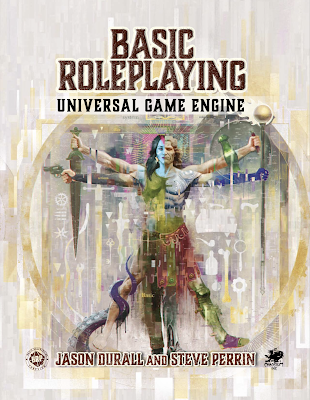
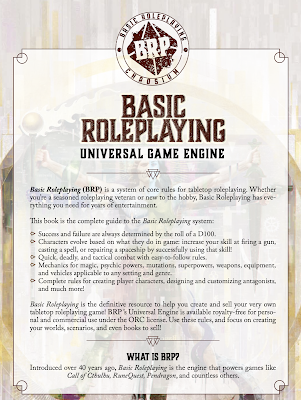
BASIC ROLEPLAYING UNIVERSAL GAME ENGINE, A REVIEW OF THE 2023 RERELEASE

A Few Brief Notes Before We Begin

I reviewed Basic Roleplaying (hereafter BRP) pretty extensively back in 2020. If you are new to the game, and want an in-depth look at it, please look there first. Here, I am going to talk mainly about the 2023 rerelease available from Chaosium here and DriveThruRPG here.

Second, in the interest of full disclosure, I have written several books for RuneQuest and contributed to others. RuneQuest is the game that BRP was invented for, but I had nothing at all to do with the 2023 rerelease. Having used the game system for forty-one years--I have literally played every Chaosium game that used BRP and a few games produced by other companies that have--I have a bias. To be clear, I love this engine.


Not a New Edition

Credited to original author Steve Perrin and the author of the 2008 omnibus "big gold book" edition, Jason Durall, the 2023 Basic Roleplaying is a revision and a rerelease of a classic. I picked those three words carefully. This is a revision and rerelease of the 2008 big gold book. Nowhere does it present itself as a new edition. If you are expecting a complete rewrite and overhaul of the game system--as with 3e, 4e, or 5e of Dungeons & Dragons--you are not going to get it. That is because of the third word I used, classic. You don't rewrite the rules of chess every time a new chess set is released. You don't need to. BRP has been played, tested, and loved all over the world for more than four decades. It remains immensely popular in Chaosium games like RuneQuest Roleplaying in Glorantha and Call of Cthulhu, not to mention games produced by other companies, such as Delta Green or Aqularre. If it isn't broken, don't fix it.

Okay Then Drew, Why A New Revision?

Because there are smart people at Chaosium.

Look, let's get the elephant out of the room first. Earlier this year the gaming industry was rocked by Wizards of the Coast and Hasbro attempting to yank the Open Game License, effectively trying to remonopolize something that had been open for 23 years. The response of other companies, led by Paizo and companies like Chaosium, was to create a true, irrevocable, open game license, the Open RPG Creative (ORC) License. This would not be held by any specific company--who might be tempted as Hasbro was to yank it later--but like similar licenses would be held in trust to ensure systems participating in the license remained open to fair use. Chaosium, which already had an open game license for Basic Roleplaying, knew this was a smart move and committed to it nearly right away. The new rerelease of BRP was to get it out under the ORC license...but instead of just re-issuing the 2008 BRP, they moved rapidly to put together the art and lay-out teams responsible for the terrific look of recent Chaosium products to make 2023 BRP worthy of being on the shelves alongside any modern RPG product.

2023 BRP is not just "sexier" than the previous release, however. This is where Jason Durall comes in. The release is cleaner, leaner, and up-to-date in terms of language. 

What's In It?

The core mechanic of BRP is roll percentile dice under a skill or characteristic percentage. That's it. If you have "First Aid" at 55% on your character sheet, and you roll a 55 or less on two ten-sided dice, you succeed. Everything your character can do is right there on the character sheet, with a percentage beside it. If you don't have a skill that applies, take one of your characteristics--Strength, Constitution, Size, Intelligence, Power, Dexterity, Charisma, (and in modern settings Education)--multiply it by five and roll under the result as a percentage.

That's it. That's the entire system.

The rest is optional. Basic Roleplaying draws on previous games that have used its mechanics (RuneQuest, Call of Cthulhu, Stormbringer, Superworld, Ringworld, ElfQuest, Pendragon, Nephilim, etc) to pull together a ton of optional rules. You are not required to use any of them, but they are there in case your campaign needs them. 

For example, "hit points." The default method to determine how many hit points your character has--effectively the amount of damage they can take before being incapacitated or killed--is to average your Constitution (health, endurance) and Size. But what if you want something grittier and more realistic? There is an optional rule for "hit locations," where limbs, torso, head, etc have their own hit points. What if you want a more heroic option? Use "total hit points" and add your Constitution and Size rather than averaging them.


Again, BRP is a rules buffet. Take what you like, ignore the rest.

Playing a horror game? Use the optional Sanity rules adapted from Call of Cthulhu. Running a superhero game? The "Powers" chapter is for you. "Spot Rules" has rules for almost anything you can conceive of--aimed attacks, acid, asphyxiation, aerial combat (and that is just a few of the "A's")--but again, they are options if you need them. You can very easily turn BRP into whatever sort of genre you need it to be. 

What's New?

We have some goodies from the latest edition of RuneQuest. Passions are here, more (again, OPTIONAL) ways to define the psychology of your character and use them in the game. Reputation is here too, showing how recognizable your character is and what people think about them. Augments are here, using Passions or skills to provide a bonus to specific rolls. For example, you want to use your Bargain skill to negotiate a deal. You might augment it with Insight...getting a "read" on the people you are bargaining with and using that for your negotiations. 

What Is Not Here?

The percentile characteristics of Call of Cthulhu are absent (easy enough to do yourself...just multiply by 5). Pushing is missing, as are bonus and penalty dice. I think the message here is "if you were thinking of using the ORC to produce Call of Cthulhu supplements outside of the Miskatonic Repository," think again. As a Jonstown Compendium author, to my mind that is fair.

Also missing is some of the simplification used in Rivers of London. But to be fair, none of that was ever BRP, it was specific to RoL.

Final Thoughts

Look, if you have the 2008 edition, you do not need the 2023. That has never been the way Chaosium played the game. Early on, D&D learned that to sell copies you have to reinvent the wheel every five years. But Call of Cthulhu barely changed through six editions, and even the 7th edition is essentially the same game. RuneQuest Roleplaying in Glorantha is basically 1978's RQ2 with additional features. Sharks have not evolved since prehistoric times because they haven't needed to. Sometimes a design is just classic.

Having said this, you should want the 2023 revision. It reads better, it is cleaner, and it has the amazing production values of modern Chaosium products. I am not throwing my copies of the big gold book out, but I am looking forward to the print version of the 2023 and it will be the one I use going forward.

This is one of the simplest, most flexible, most customizable engines in the tabletop gaming business. That is why it has lasted this long. You can talk about antiquated game systems, about out-of-date mechanics, but you are saying nothing other than personally preferring your Pokemon cards to chess. There is nothing wrong with that, but there is nothing wrong with a classic either. This is a definitive update of a definitive game system.